


 NECKLACES

 Shop now, pay later
Rutilated Quartz
quartz family
Rutilated Quartz jewelry
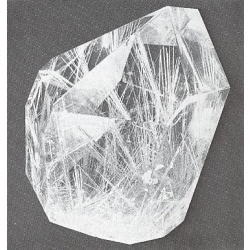
Rutilated Quartz is a variety of macrocrystalline quartz (SiO₂) containing needle-like inclusions of rutile, a titanium dioxide mineral (TiO₂). The host quartz is typically clear, smoky, or milky, while the rutile needles range from golden yellow and copper-red to silver, black, and reddish-brown depending on iron content. Collectors often call the golden variety "Venus hair stone" or "angel hair" for the fine, hair-thin strands suspended in the crystal. Each stone has a different inclusion pattern, which is why Rutilated Quartz is prized as much as a natural specimen as it is a gem.
Origin and Key Properties of Rutilated Quartz
The most important commercial source is Brazil, specifically the states of Minas Gerais and Bahia, where rutilated quartz is pulled from pegmatite veins alongside other quartz varieties. Smaller but notable deposits occur in Madagascar, Pakistan, Kazakhstan, Australia, and the United States (North Carolina and Georgia). Brazilian material tends to show the cleanest host crystal and the brightest golden rutile, which keeps it dominant in the gem trade.
Quartz rates 7 on the Mohs hardness scale, making it durable enough for daily-wear rings, pendants, and earrings. The host crystal is transparent to translucent with a vitreous luster and a specific gravity near 2.65. Rutile inclusions themselves are harder to classify optically — they appear as straight or radiating needles, sometimes in star-like bursts called sagenite. Color in the host ranges from water-clear rock crystal to pale gray and brown smoky quartz, the latter caused by natural or lab-induced gamma radiation acting on trace aluminum.
Treatments are usually minimal. Most Rutilated Quartz on the market is untreated — the inclusions are what buyers want, so heating or dyeing would defeat the purpose. Some smoky-host material is irradiated to deepen the background and make the rutile needles stand out. Reputable sellers disclose this; at SilverRush Style we list any treatment on the product page.
Rutilated Quartz in Sterling Silver Jewelry
Because the interior of the stone is the feature, lapidaries favor cuts that show depth: cabochons, smooth domes, briolettes, and simple step or emerald cuts. Faceted rounds and ovals also work when the rutile is dense enough to read through the crown. Raw and slice cuts have become popular for statement pendants, since a thin section reveals the full network of needles. Sterling silver (.925) suits the stone for two practical reasons — its cool white tone doesn't compete with golden or copper rutile, and its lower price lets the setting stay proportional to a stone that is often cut large. Our rutilated quartz jewelry collection generally runs from about $35 for small earrings and rings up to $180 for larger pendants and cuffs.
Bezel and prong settings both work well; bezels protect the girdle on softer specimens with heavy inclusions, while prongs maximize light entry for cleaner cabochons. Open-back settings are common on pendants because light passing through the quartz makes the rutile glow.
Care and Cleaning
Clean Rutilated Quartz with warm water, mild dish soap, and a soft brush. Avoid ultrasonic and steam cleaners — the rutile needles create internal stress points that can fracture under vibration or thermal shock. Keep the stone away from bleach, acetone, and chlorinated pool water, and store it separately from harder gems like topaz or sapphire to prevent surface scratches. Prolonged direct sunlight is fine for clear hosts but can lighten irradiated smoky quartz over time.
Frequently Asked Questions
Is Rutilated Quartz a real, natural stone?
Yes. It forms naturally when rutile crystals grow inside quartz during the cooling of silica-rich fluids in pegmatite veins. The needles are solid mineral inclusions, not fibers added after cutting.
What is the difference between rutilated and tourmalinated quartz?
Rutilated quartz contains rutile (TiO₂) needles, usually gold, red, or copper-colored. Tourmalinated quartz contains black schorl tourmaline inclusions that are thicker and more angular. Both are quartz hosts with a Mohs hardness of 7.
Can Rutilated Quartz be worn every day?
At Mohs 7 it handles daily wear in pendants, earrings, and occasional-wear rings. For rings worn constantly, choose a bezel setting and remove the piece before heavy manual work to protect the inclusions from impact.
Does Rutilated Quartz fade or change color?
Clear-host rutilated quartz is color-stable. Irradiated smoky-host material can lighten with long UV exposure, so store those pieces out of direct sunlight when not worn.
Talk to Our Jewelry Experts
Monday to Friday from 9AM to 5PM EST
