


 NECKLACES

 Shop now, pay later
Rose Quartz
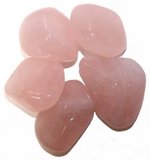
quartz family
Rose Quartz jewelry
Rose Quartz is a pink variety of macrocrystalline quartz, a silicon dioxide (SiO₂) mineral colored by trace amounts of titanium, iron, manganese, or microscopic fibers of dumortierite. Its shade runs from pale blush to a deeper rose-red, with transparency ranging from nearly clear to milky translucent. The stone belongs to the trigonal crystal system and forms in massive habit far more often than as distinct crystals, which is why most gem-quality material is cut as cabochons or beads rather than faceted stones.
Origin and Key Properties of Rose Quartz
The bulk of commercial Rose Quartz comes from pegmatite deposits in Minas Gerais and Bahia, Brazil, which has supplied the global market since the mid-20th century. Madagascar produces some of the finest deeper-pink material, and significant deposits also come from Namibia, Mozambique, South Africa, and the United States, particularly the Black Hills of South Dakota, where Rose Quartz is the state mineral. Rare euhedral pink quartz crystals — a distinct variety sometimes sold as "crystalline rose quartz" — are found at the Sapucaia and Pitorra mines in Brazil.
Rose Quartz rates 7 on the Mohs scale, with a specific gravity of 2.65 and a refractive index between 1.544 and 1.553. The color in massive material is often caused by microscopic pink fibers of a dumortierite-like mineral; this is why many pieces show a faint cloudy appearance and, in well-oriented cabochons, a six-rayed asterism under a single light source. The stone is usually free of the fractures and cleavage issues that plague softer gems.
Treatments are uncommon with this stone, which is one reason it remains affordable. The color is natural and is not produced by heat or irradiation in the vast majority of commercial goods. Some pale material can fade with prolonged UV exposure, so the color you buy is generally the color you keep if stored sensibly. Dyed quartz exists on the low end of the market but is rare in reputable sterling silver jewelry.
Rose Quartz in Sterling Silver Jewelry
Because most Rose Quartz is translucent rather than transparent, cabochons, cameos, beads, and smooth briolettes dominate jewelry use. Cleaner material from Madagascar and Brazil is occasionally faceted into rounds, ovals, and checkerboard cuts for rings and pendants, though faceted pieces over 10 carats with good clarity command a premium. The cool, white metal tone of sterling silver (.925) sets off the soft pink without the warm cast that yellow gold introduces, which is why silver mountings are the standard choice for this stone.
At SilverRush Style, most rose quartz jewelry falls in the $25 to $120 range, with larger statement rings and multi-stone necklaces reaching higher. We stock cabochon rings, bead strands, drop earrings, and pendants set in solid .925 sterling — no plating, no fillers.
Care and Cleaning
Clean Rose Quartz with warm water, mild dish soap, and a soft brush. Skip ultrasonic and steam cleaners if the stone shows visible fractures, and keep it away from bleach, acetone, and jewelry dips that attack the silver. Store pieces in a lined box or pouch out of direct sunlight to prevent any color shift, and keep them separate from harder stones like topaz and sapphire that can scratch the surface.
Frequently Asked Questions
Is Rose Quartz a real gemstone?
Yes. Rose Quartz is a natural silicon dioxide mineral and a recognized semi-precious gemstone used in jewelry for centuries. It is mined commercially in Brazil, Madagascar, Namibia, and the US, and is not a synthetic or lab-made material.
How can you tell if Rose Quartz is genuine?
Natural Rose Quartz usually has a slightly cloudy or milky character with uneven color distribution and internal wisps. Glass imitations look too clear, show rounded bubbles under magnification, and feel warmer to the touch. Natural stone registers 7 on Mohs and will scratch glass.
Can Rose Quartz be worn every day?
At Mohs 7 it holds up well in pendants, earrings, and occasional-wear rings. For daily-wear rings, choose a protective bezel setting and remove the piece before gardening, gym workouts, or cleaning with harsh chemicals.
Does Rose Quartz fade in sunlight?
Pale specimens can lose a small amount of color after long-term UV exposure. Store jewelry in a dark box or pouch when not worn, and avoid leaving pieces on sunny windowsills for extended periods.
Talk to Our Jewelry Experts
Monday to Friday from 9AM to 5PM EST
