

 NECKLACES

 Shop now, pay later
Smoky Quartz
quartz family
Smoky Quartz jewelry
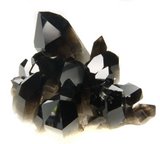
Smoky Quartz is a macrocrystalline variety of quartz (silicon dioxide, SiO₂) colored by natural gamma irradiation acting on trace aluminum within the crystal lattice. Its color ranges from pale champagne brown through warm cognac to deep, near-black morion, with transparency from water-clear to fully opaque like the specimen shown here. The stone sits firmly in the quartz family alongside amethyst, citrine, and rose quartz, and has been used in jewelry and optics for centuries.
Smoky Quartz Origin and Key Properties
Commercial Smoky Quartz comes from several well-documented deposits: the Swiss and Austrian Alps (where the stone has been collected since the Middle Ages and called "Cairngorm" when sourced from the Scottish Highlands), Minas Gerais and Goiás in Brazil, Madagascar, the Pikes Peak region of Colorado, the Ukrainian Volyn pegmatite field, and Arkansas. Scottish Cairngorm material was historically mounted in Highland dress accessories and remains the namesake of a Caledonian jewelry tradition.
The mineral scores 7 on the Mohs scale, making it hard enough for daily-wear rings and bracelets. Chemical formula is SiO₂, crystal system trigonal, specific gravity around 2.65, and refractive index 1.544–1.553. Colors run from light smoky brown to chocolate, olive-brown, and opaque black (morion). The darkest opaque form, like the specimen above, often shows a dense uniform color with no visible matrix or inclusions.
Treatment disclosure matters here. A significant portion of commercial Smoky Quartz on the market is pale or colorless quartz that has been irradiated to produce or deepen the brown color; the result is stable and indistinguishable from naturally irradiated material without lab testing. Some very dark stones are also heat-treated to lighten them into a more marketable cognac tone. At SilverRush Style we source natural and irradiated material — both are accepted in the trade and the color is permanent under normal wear.
Smoky Quartz in Sterling Silver Jewelry
Transparent Smoky Quartz is most often faceted into oval, cushion, emerald, and round brilliant cuts to show off its clarity and warm color. Denser or included rough is cut en cabochon for rings and pendants, while collector-grade crystal points and raw terminations are wire-wrapped for statement pieces. The brown-to-black palette reads as a neutral, which is why it pairs well with the cool white of sterling silver (.925); the metal frames the stone without competing with it, unlike yellow gold which can push the color toward muddy.
Our smoky quartz jewelry catalog runs from about $25 for small cabochon stud earrings up to $120–180 for larger faceted cocktail rings and statement pendants. Bezel and prong settings in sterling are the two most common mountings, with bezels preferred for cabochons and opaque morion, and four- or six-prong heads used for faceted stones to let light pass through the pavilion.
Care and Cleaning
Clean Smoky Quartz with warm water, mild dish soap, and a soft toothbrush; rinse and dry with a lint-free cloth. Ultrasonic and steam cleaners are generally safe for untreated stones but should be avoided for irradiated material, since heat can fade the color. Keep the stone out of prolonged direct sunlight for the same reason, and store pieces separately in a soft pouch to prevent sterling silver from scratching softer stones in your collection.
Frequently Asked Questions
Is Smoky Quartz a real gemstone?
Yes. Smoky Quartz is a natural macrocrystalline quartz, the same mineral family as amethyst and citrine. It is cut and set as a semi-precious gemstone and has been used in European and Scottish jewelry for several hundred years.
What is Smoky Quartz good for?
In metaphysical traditions Smoky Quartz is associated with grounding, the root chakra, and stress relief; practitioners use it to absorb negative energy and promote calm focus. Practically, its Mohs 7 hardness and neutral color also make it a durable everyday stone for rings and pendants.
Is Smoky Quartz expensive?
No. Smoky Quartz is one of the more affordable transparent gemstones. Faceted stones typically trade at $2–10 per carat at retail, with exceptional large clean Cairngorm or Colorado specimens commanding more. Finished sterling silver pieces at SilverRush Style start around $25.
How can you tell if Smoky Quartz is real?
Real Smoky Quartz feels cool to the touch, scratches glass (Mohs 7), and shows a specific gravity near 2.65. Under magnification look for natural inclusions or growth phantoms; perfectly flawless, uniformly colored stones at very low prices are often glass imitations. Gemological testing of refractive index confirms identification.
Talk to Our Jewelry Experts
Monday to Friday from 9AM to 5PM EST
