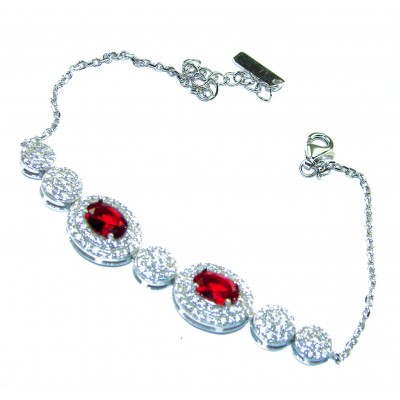


 NECKLACES

 Shop now, pay later
Opal
opal family
Opal jewelry
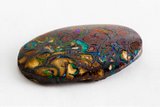
Opal is a hydrated amorphous form of silica (SiO₂·nH₂O) containing 3% to 21% water by weight, classified as a mineraloid rather than a true mineral because it lacks a crystalline structure. The stone ranges from milky white and black to brown, orange, yellow, blue, and green, with precious varieties showing a phenomenon called play-of-color — flashes of spectral hues that shift with viewing angle. The specimen shown here is a brown boulder opal cabochon with blue, green, and purple fire set against a natural ironstone matrix. The name traces back to the Latin opalus and Sanskrit upala, both meaning "precious stone."
Origin and Key Properties of Opal
Australia produces roughly 95% of the world's precious opal, with major deposits at Coober Pedy and Andamooka in South Australia (white and crystal opal), Lightning Ridge in New South Wales (black opal), and Queensland's Winton-Quilpie belt (boulder opal, the variety pictured). Ethiopia's Welo province emerged as a significant source after 2008, producing hydrophane opal with strong play-of-color. Mexico contributes fire opal in orange and red tones, while Brazil, Peru, and Honduras supply smaller volumes. Historical mining dates to Roman-era extraction from what is now Slovakia's Dubník deposit, which was the primary European source for nearly two millennia.
Opal rates 5.5 to 6.5 on the Mohs scale, softer than quartz, which means it requires care in daily wear. Transparency spans opaque to transparent. The play-of-color comes from silica spheres 150 to 300 nanometers in diameter arranged in close-packed lattices that diffract light — larger spheres produce red flash, smaller ones blue. Opalescence, by contrast, is the milky bluish sheen caused by simple light scattering and should not be confused with true play-of-color.
Treatments are common and buyers should ask before purchasing. Smoke treatment and sugar-acid treatment darken light Ethiopian opal to mimic black opal. Doublets (opal slice glued to a dark backing) and triplets (with a clear quartz cap) are assembled stones sold at lower prices. Some opals are impregnated with resin or oil to stabilize cracks. Untreated Australian opal is the standard for investment-grade material, and reputable sellers disclose any enhancement.
Opal in Sterling Silver Jewelry
Opal is almost always cut as a cabochon — a smooth, domed shape that maximizes play-of-color and avoids the stress of faceting on a soft stone. Freeform cuts follow the shape of boulder opal seams, and inlay work is common for thin slices. Sterling silver (.925) is a practical partner for opal: the cool white metal does not compete with the stone's internal color, and silver bezels offer better protection for the soft edges than prong settings. Our opal jewelry collection at SilverRush Style typically runs $30 to $180, depending on whether the stone is Ethiopian, Australian crystal, or boulder opal, with rings and pendants dominating the selection.
Care and Cleaning
Clean opal with warm water, mild soap, and a soft cloth. Never use ultrasonic or steam cleaners — vibration and heat can crack the stone, and hydrophane opal will absorb water and temporarily lose its fire. Avoid household chemicals, perfume, and prolonged direct sunlight, which can dehydrate the stone over time. Store opal jewelry separately in a padded pouch, and for long-term storage of hydrophane varieties, some collectors keep a small damp cotton ball in the box.
Frequently Asked Questions
Is opal a real gemstone?
Yes. Opal is a recognized gemstone and the official birthstone for October, alongside tourmaline. It is classified as a mineraloid because it lacks crystalline structure, but it has been used in jewelry for over 2,000 years.
Can you wear opal jewelry every day?
Opal pendants and earrings are fine for daily wear since they take less impact. Opal rings need more caution — remove them before cleaning, gardening, or sports, because the 5.5 to 6.5 Mohs hardness makes the stone prone to scratches and chips.
What is the difference between boulder opal and black opal?
Boulder opal is a thin seam of precious opal still attached to its host ironstone, which forms a natural brown backing. Black opal is solid precious opal with a dark body tone, mined primarily at Lightning Ridge. Black opal commands higher prices per carat, while boulder opal offers strong color at a lower cost.
Does opal need water to stay hydrated?
Australian opal contains stable structural water and does not need soaking. Ethiopian hydrophane opal is more porous and can dry out or absorb liquids and oils. Keep hydrophane opal away from heat sources and avoid prolonged exposure to dry air.
Talk to Our Jewelry Experts
Monday to Friday from 9AM to 5PM EST
Recently Viewed