


 NECKLACES

 Shop now, pay later
Fire Opal
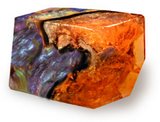
opal family
Fire Opal jewelry
Fire Opal is a variety of hydrated silica (SiO₂·nH₂O) prized for its warm body color, which ranges from pale yellow through orange to deep red. Unlike precious opal, most Fire Opal is transparent to translucent and shows little to no play-of-color, relying instead on the saturation of its base hue for visual impact. It belongs to the amorphous silica group and contains 3-10% water by weight, a factor that affects both its appearance and its care requirements.
Origin and Key Properties of Fire Opal
The most important source is Querétaro, Mexico, where Fire Opal has been mined since pre-Columbian times — the Aztecs called it quetzalitzlipyollitli, or "stone of the bird of paradise." Commercial deposits there occur in rhyolitic volcanic host rock at sites such as San Juan del Río and La Trinidad. Secondary producers include Ethiopia (Wegel Tena and Shewa), Brazil (Piauí state), Turkey, and smaller finds in Oregon and Nevada. Ethiopian material entered the market in volume after 2008 and is typically more hydrophane than Mexican stone, meaning it absorbs water and can temporarily change transparency.
Fire Opal rates 5.5 to 6.5 on the Mohs scale, lower than quartz, with a specific gravity of roughly 1.98-2.20 and a refractive index near 1.37-1.47. Colors are caused by trace iron oxides. The stone is softer than most faceted gems and sensitive to heat, dehydration, and sudden temperature changes, which can cause crazing — a network of fine internal cracks.
Treatments to disclose: Ethiopian hydrophane opal is sometimes smoke-treated or sugar-treated to darken the body and imitate black opal; some material is polymer-impregnated for stability. Mexican Fire Opal is usually sold untreated but may be stabilized with resin if the raw rough is prone to cracking. Reputable sellers declare these treatments; assume natural, untreated unless stated otherwise.
Fire Opal in Sterling Silver Jewelry
Because Fire Opal is softer than sapphire or topaz, it is most often cut as a cabochon for rings, pendants, and earrings, though clean Mexican material with strong saturation is faceted into ovals, rounds, and pears. Raw and free-form cuts also suit the stone's fiery body color. Sterling silver (.925) is a practical setting choice: the cool white metal sharpens the orange-red tones without competing with them, and bezel settings in silver protect the vulnerable girdle from knocks. Browse our fire opal jewelry collection for current pieces; prices at SilverRush Style typically run from about $25 for small cabochon earrings to $120+ for statement rings with larger Mexican stones.
When buying, look at body tone (deeper reds command higher prices than pale yellows), clarity, and whether the cutter left enough material for a secure setting. A stone with even minor crazing should be avoided for daily-wear rings.
Care and Cleaning
Clean Fire Opal with lukewarm water, mild soap, and a soft cloth. Avoid ultrasonic and steam cleaners, household chemicals, and prolonged direct sunlight or dry heat, all of which can dehydrate the stone and trigger crazing. Store pieces separately in a soft pouch; for hydrophane Ethiopian material, keep it away from oils, perfume, and lotion.
Frequently Asked Questions
Are Fire Opals real gemstones?
Yes. Fire Opal is a natural variety of opal mined primarily in Mexico, Ethiopia, and Brazil. It is recognized by the GIA and graded alongside other opal varieties. Synthetic and imitation Fire Opals exist, so ask the seller for material origin.
What is the difference between Mexican and Ethiopian Fire Opal?
Mexican Fire Opal is volcanic in origin and tends to be non-hydrophane, with transparent orange-to-red body color. Ethiopian Fire Opal is sedimentary and often hydrophane — it absorbs water and can change clarity temporarily. Ethiopian material is generally less expensive per carat.
Does Fire Opal show play-of-color like other opals?
Usually not, or only faintly. Fire Opal is valued for its saturated warm body color rather than the rainbow flash seen in precious white or black opal. Stones that show both strong body color and play-of-color are rare and carry a premium.
Can Fire Opal be worn every day?
With a Mohs hardness of 5.5-6.5, Fire Opal is better suited to earrings, pendants, and occasional-wear rings than to daily rings. If worn often, choose a protective bezel setting and remove the piece before cleaning, swimming, or manual work.
Talk to Our Jewelry Experts
Monday to Friday from 9AM to 5PM EST
