

 NECKLACES

 Shop now, pay later All Bracelets & Necklaces 96% OFF + All Rings 96% OFF
 Helenite
family
Helenite jewelry
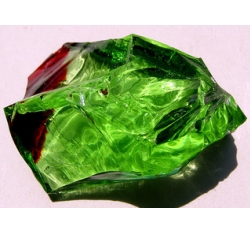
Helenite is a man-made glass gemstone created from volcanic ash ejected during the 1980 eruption of Mount St. Helens in Washington State. Often sold as emerald green, it also appears in red and blue varieties produced by adding trace metal oxides during the melt. The material sits in the amorphous silica glass family rather than the crystalline mineral group, though its chemistry mirrors the andesitic ash it comes from.
Origin and Key Properties of Helenite
The source material was collected from the pyroclastic flows and ash deposits left after Mount St. Helens erupted on May 18, 1980, in Skamania County, Washington. Workers clearing debris from logging equipment noticed the ash melted into green glass under acetylene torches, and small-batch production followed. Most helenite on the market today is still produced in the US Pacific Northwest from stockpiled ash, though similar obsidian-style glasses are now manufactured overseas and sold under the same trade name.
Helenite measures roughly 5.5 on the Mohs scale, comparable to standard glass and softer than quartz. Chemically it runs about 60% silicon dioxide (SiO₂) with around 17% aluminum oxide, 6% iron oxide, and 5% calcium oxide, plus trace elements. It is transparent to translucent with a glassy (vitreous) luster and no crystal structure, which lets cutters facet it cleanly without cleavage concerns. The signature green comes from iron content in the original ash; red is produced with added gold chloride, and blue helenite comes from cobalt additions during fusion at roughly 2,700°F.
Every helenite on the market is treated by definition — it is melted, recast, and often faceted from reformed glass. Reputable sellers disclose this. No dyes, fracture fillers, or irradiation are applied after cutting; the color is set in the melt.
Helenite in Sterling Silver Jewelry
Because helenite takes a precise facet, it is most often cut into round brilliants, ovals, pears, and emerald cuts that show off its clarity. Cabochons exist but are less common. The cool white of sterling silver (.925) keeps the green and blue varieties reading clean rather than yellow-shifted, which is why our helenite jewelry collection — rings, pendants, and earrings — is built on silver rather than plated base metals. Price range at SilverRush Style typically runs from about $25 for simple stud earrings up to around $120 for larger faceted pendants and statement rings.
Red helenite, marketed as "ruby" helenite, and blue helenite command a small premium over green because the colorants cost more to produce. Carat-for-carat, helenite remains one of the more affordable transparent green stones available in sterling silver settings, well below the cost of natural emerald or tsavorite.
Care and Cleaning
Clean helenite with warm water, mild dish soap, and a soft cloth or soft brush. Avoid ultrasonic and steam cleaners — the thermal shock can fracture glass. Keep the stone away from bleach, acetone, and abrasive polishes, and remove jewelry before gardening or gym work since helenite scratches more easily than quartz. Store pieces in a lined pouch or a separate compartment so harder stones don't nick the facets.
Frequently Asked Questions
Is helenite a real gemstone?
Helenite is a real, physical gem material but it is not a natural mineral. It is volcanic glass produced by melting Mount St. Helens ash at about 2,700°F and recasting it. Think of it as a lab-created silica glass with a specific geological source.
What is the difference between helenite and emerald?
Emerald is a natural beryl crystal (Mohs 7.5–8) colored by chromium or vanadium, usually with visible inclusions. Helenite is a man-made glass (Mohs 5.5) with no crystal structure and typically eye-clean clarity. They share a green color range but differ in hardness, origin, and price.
How much is helenite worth?
Loose helenite trades for roughly $2 to $10 per carat depending on color, cut quality, and size. Red and blue varieties sit at the higher end. Finished sterling silver pieces at SilverRush Style generally run $25 to $120.
Can helenite be worn every day?
Helenite works well in pendants and earrings for daily wear. For rings, treat it as an occasional-wear stone since its 5.5 hardness means it can scratch against harder surfaces. Protective bezel settings in sterling silver extend its life in ring form.
Talk to Our Jewelry Experts
Monday to Friday from 9AM to 5PM EST
Recently Viewed