


 NECKLACES

 Shop now, pay later All Bracelets & Necklaces 96% OFF + All Rings 96% OFF
 Azurite
family
Azurite jewelry
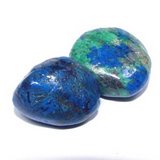
Azurite is a soft copper carbonate mineral prized for its deep blue color, forming as a secondary mineral in the oxidized zones of copper ore deposits. With the chemical formula Cu₃(CO₃)₂(OH)₂, it belongs to the monoclinic crystal system and ranges from pale sky blue to near-black indigo depending on crystal size and density. The stone often occurs alongside malachite, producing mixed blue-green specimens known as azurite-malachite.
Origin and Key Properties of Azurite
Significant deposits have been mined at Chessy-les-Mines near Lyon, France (the source of the alternate name Chessylite), Tsumeb in Namibia, Bisbee and Morenci in Arizona, Touissit in Morocco, and Guangdong Province in China. The Bisbee and Tsumeb localities are historically known for producing the sharpest crystal specimens, while Chinese and Moroccan material supplies most cabochon-grade rough on the current market.
Azurite measures 3.5 to 4 on the Mohs scale, making it one of the softer stones used in jewelry. It is typically opaque to translucent, with a vitreous luster on crystal faces and a duller finish on massive material. Specific gravity runs 3.77 to 3.89. Color ranges from azure blue to dark violet-blue; the stone can gradually alter to green malachite when exposed to humidity over long periods, which is why older specimens often show green patches at the surface.
Most azurite used in jewelry is untreated — the color is natural. Because the material is porous and fragile, cabochons are frequently stabilized with a clear resin or wax to harden the surface and lock in color. Some lower-grade pieces are reconstituted (crushed azurite bonded with resin); this should be disclosed at point of sale. We do not dye or color-enhance azurite.
Azurite in Sterling Silver Jewelry
Given its hardness, azurite is almost always cut as a cabochon rather than faceted. Domed ovals, freeforms, and rounds dominate, and azurite-malachite blends are popular for their swirled blue-green patterning. Raw druzy clusters also appear in pendants and statement rings where the crystal texture can be protected by a bezel. Sterling silver (.925) is the standard setting metal because its cool gray tone reinforces the blue without competing with it, and a bezel mount shields the stone's vulnerable edges. Browse our azurite jewelry collection for current pieces; typical retail at SilverRush Style runs $35 to $120 depending on stone size, carat weight, and setting complexity.
Pendants and earrings are the most practical formats since they avoid the impacts and abrasion that rings face daily. If you want an azurite ring, choose a low-profile bezel and reserve it for occasional wear.
Care and Cleaning
Clean azurite only with a soft, slightly damp cloth. Avoid ultrasonic cleaners, steam cleaners, hot water, and all household chemicals including ammonia and bleach — these will damage the stone and can strip stabilizing resin. Prolonged exposure to heat or direct sunlight may fade the blue. Store the piece in a padded box away from harder gems that could scratch it, and keep it dry; high humidity accelerates conversion to malachite.
Frequently Asked Questions
Is azurite a rare stone?
Azurite is not rare as a mineral species, but gem-quality material with deep saturated color and enough stability to cut is uncommon. Top specimen-grade crystals from Bisbee or Tsumeb command high prices among collectors.
Can azurite get wet?
Brief contact with cool water is fine, but the stone should not be soaked. Water and humidity accelerate the chemical change from azurite into malachite, dulling the blue color over time.
Why is some azurite green?
Azurite naturally alters into malachite, a related copper carbonate, through exposure to moisture. Stones showing both blue and green zones are sold as azurite-malachite and are geologically authentic, not a treatment.
Is azurite safe to wear?
Finished and sealed azurite jewelry is safe for normal wear. The mineral does contain copper, so avoid handling raw or powdered azurite, and wash your hands after touching unsealed rough specimens.
Talk to Our Jewelry Experts
Monday to Friday from 9AM to 5PM EST
