

 NECKLACES

 Shop now, pay later All Bracelets & Necklaces 96% OFF + All Rings 96% OFF
 Apatite
family
Apatite jewelry
Apatite is a calcium phosphate mineral group (Ca₅(PO₄)₃(F,Cl,OH)) best known to jewelry buyers for its saturated neon blue to teal color, though it also occurs in green, yellow, violet, pink, and colorless material. The name comes from the Greek apatao, "to deceive," because specimens were historically mistaken for beryl, topaz, tourmaline, and peridot. It reads as transparent to translucent when gem-grade, and the blue Madagascar material — the type shown on this page — is the variety most shoppers encounter in silver settings.
Apatite Origin and Key Properties
Commercial apatite comes from Brazil (Minas Gerais), Madagascar, Mexico, Myanmar, Sri Lanka, Kenya, Mozambique, Norway, India, and parts of the United States (Maine and California). Madagascar is the main source of the electric blue-green "Paraíba-like" apatite seen in modern jewelry. Mexican deposits produce yellow material, and Brazilian mines yield neon blue-green and bluish-green crystals. Apatite is also the reason teeth and bones are hard — hydroxyapatite is the primary mineral in human skeletal tissue.
Apatite sits at 5 on the Mohs scale, which defines that point on the scale. Specific gravity runs 3.16–3.22, and the refractive index falls between 1.63 and 1.64. Cleavage is indistinct but the stone is brittle, which matters more than the Mohs number alone when setting and wearing it. Colors are driven by trace elements: rare earths and manganese produce yellow, while the blue and blue-green hues come from trace amounts of rare earth elements as well.
Treatment disclosure: most blue apatite on the market is heat-treated to deepen and stabilize color, a standard and accepted practice. Some green and yellow stones are untreated. Fracture-filling and dyeing are rare in apatite but do occur with lower-grade cabochon material — reputable sellers disclose this. Assume heat treatment unless a stone is specifically sold as untreated.
Apatite in Sterling Silver Jewelry
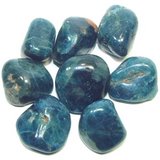
Gem-grade apatite is typically faceted into ovals, cushions, rounds, and pears to show off its color saturation. Opaque and translucent blue material — like the tumbled specimens pictured — is cut into cabochons, beads, and briolettes for pendants and earrings. Raw and rough-cut apatite also appears in statement pieces. Sterling silver (.925) is a natural match because the cool white metal pushes the blue and teal tones forward without the warm bias that yellow gold introduces. Our apatite jewelry collection typically runs $25–$120, with faceted solitaire rings and multi-stone pendants at the upper end.
Because apatite is softer and more brittle than quartz or topaz, design choices matter. Bezel settings and protected prong settings extend the life of rings and bracelets. Earrings, pendants, and brooches put the stone out of harm's way and are the safest everyday formats. Reserve apatite rings for occasional wear rather than daily use.
Care and Cleaning
Clean apatite with warm water, mild soap, and a soft cloth or soft brush. Do not use ultrasonic or steam cleaners — heat and vibration can fracture the stone and reverse heat-enhanced color. Keep apatite away from household chemicals, acids, perfume, and prolonged direct sunlight, which can fade some green and yellow material. Store pieces separately in a soft pouch so harder stones (quartz, topaz, sapphire) do not scratch the surface.
Frequently Asked Questions
How does apatite form?
Apatite forms in a wide range of geological settings. Most gem-quality crystals grow in pegmatites — slow-cooling, phosphorus-rich igneous pockets where large crystals have room to develop. It also forms in metamorphic rocks, carbonatites, and hydrothermal veins, and as a secondary mineral in sedimentary phosphate deposits. Biological apatite (hydroxyapatite) is produced by living organisms in bone and tooth enamel.
What does apatite look like?
Gem apatite ranges from transparent to opaque and comes in neon blue, teal, green, yellow, violet, pink, brown, and colorless. The blue Madagascar variety is the most recognizable — a saturated greenish-blue often compared to Paraíba tourmaline. Rough crystals form hexagonal prisms, while tumbled and cabochon stones show a smooth, glassy to waxy luster.
Is apatite durable enough for everyday jewelry?
At Mohs 5, apatite is softer than quartz (7) and can scratch against everyday surfaces. It is well suited to earrings, pendants, and brooches for daily wear. For rings and bracelets, choose bezel-set pieces and treat them as occasional-wear jewelry.
Is apatite treated?
Most blue apatite on the market is heat-treated to improve color, which is a stable and standard industry practice. Green and yellow apatite is often untreated. Assume heat treatment unless the seller states otherwise, and avoid prolonged sun exposure to preserve color.
Talk to Our Jewelry Experts
Monday to Friday from 9AM to 5PM EST
Recently Viewed