


 NECKLACES

 Shop now, pay later All Bracelets & Necklaces 96% OFF + All Rings 96% OFF
 Fire Agate
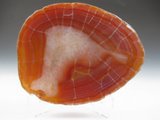
agate family
Fire Agate jewelry
Fire Agate is a rare variety of chalcedony (microcrystalline quartz, SiO₂) prized for its internal iridescence, which ranges from golden orange and red to green and violet. The specimen shown here displays the typical translucent orange body with white banding that characterizes rough material before cutting. Unlike banded agates used for cameos, Fire Agate owes its color play to thin layers of iron oxide (limonite or goethite) trapped between silica sheets, which diffract light much like a thin-film interference pattern. It is one of the few agates classified as a phenomenon gemstone.
Fire Agate Origin and Key Properties
Fire Agate occurs in a narrow geographic corridor. Commercial deposits are limited to central and northern Mexico (Chihuahua, Aguascalientes, San Luis Potosí, Calvillo) and the US Southwest — specifically Slaughter Mountain and Deer Creek in Arizona, and the Calico Mountains of California. The material formed roughly 24 to 36 million years ago during late Tertiary volcanic activity, when hot, silica-rich water moved through fractures in host rock and deposited alternating layers of chalcedony and iron oxide.
On the Mohs scale, Fire Agate reads 6.5 to 7, with a specific gravity near 2.60 and a refractive index of 1.530–1.540. The body is translucent to semi-opaque; the fire colors sit below the surface and must be reached by the cutter. Because the iridescent layer is often only a fraction of a millimeter thick, most stones are cut freeform rather than to standard calibrated shapes.
Treatment disclosure: natural Fire Agate is almost never dyed, heated, or irradiated — the color play is structural, not pigment-based, so treatments do not improve it. What varies is the cutting. Skilled lapidaries carve away overlying chalcedony to expose the fire layer, which is why two stones from the same nodule can look very different. Be wary of "fire agate" sold as calibrated round cabochons at low prices; these are often dyed common agate or glass imitations.
Fire Agate in Sterling Silver Jewelry
Because the fire sits in uneven layers, cabochons are the standard cut — typically freeform domes or lightly contoured shapes that follow the color play. Faceted Fire Agate is rare and usually disappointing, since faceting scatters the internal reflection. Raw specimen pieces also appear in pendants, though most shoppers prefer cut stones for wear.
Sterling silver (.925) suits Fire Agate for two practical reasons: the cool gray metal does not compete with the warm orange-red body color, and silver bezels can be shaped to match irregular cabochon outlines without the tooling costs of gold. At SilverRush Style, most fire agate jewelry falls between $35 and $120, with rings the most common format, followed by pendants. All stones are natural, set by hand in .925 silver.
Care and Cleaning
Clean with warm water, mild dish soap, and a soft brush. Avoid ultrasonic and steam cleaners — internal iron oxide layers can trap thermal stress and fracture. Keep away from bleach, chlorinated pool water, and strong acids, all of which etch silver and can dull the stone's polish. Store separately in a soft pouch; harder gems like topaz or quartz will scratch the surface.
Frequently Asked Questions
Is Fire Agate a rare gemstone?
Yes. Fire Agate is found in only a handful of deposits in Mexico, Arizona, and California, and high-grade material with strong multi-color fire is uncommon. It is considered one of the rarest agate varieties on the market.
What causes the fire effect in Fire Agate?
The iridescence comes from thin-film interference. Microscopic layers of iron oxide deposited between sheets of silica refract light at different wavelengths, producing the red, gold, green, and violet flashes seen through the translucent chalcedony.
How hard is Fire Agate on the Mohs scale?
Fire Agate measures 6.5 to 7 on the Mohs scale, the same range as other quartz varieties. It holds up well in rings and daily-wear jewelry but can still be scratched by harder stones such as topaz, sapphire, or diamond.
Is Fire Agate treated or enhanced?
Natural Fire Agate is not typically treated. Its color play is structural rather than chemical, so heat, dye, and irradiation do not improve it. Any "fire agate" showing painted-on color or uniform calibrated shapes should be examined closely for authenticity.
Talk to Our Jewelry Experts
Monday to Friday from 9AM to 5PM EST
