


 NECKLACES

 Shop now, pay later All Bracelets & Necklaces 96% OFF + All Rings 96% OFF
 Blue Lace Agate
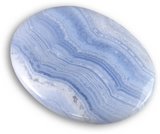
agate family
Blue Lace Agate jewelry
Blue Lace Agate is a pale sky-blue, banded variety of chalcedony — a microcrystalline form of quartz (SiO₂) — named for the fine, lace-like white and blue stripes running through the stone. Its color ranges from near-white powder blue to a deeper periwinkle, with banding that can appear as tight concentric lines or looser wavy patterns. Translucent to semi-translucent, it's prized for a soft, airy look that reads much calmer than most blue gemstones. Collectors consider it one of the more desirable agates because good material is geographically limited.
Origin and Key Properties of Blue Lace Agate
The original and still most significant source is the Ysterputs farm area in southern Namibia, near the Orange River on the edge of the Kalahari. The deposit was worked commercially starting in the 1960s by George Swanson, and rough from this locality remains the benchmark for color and banding. Smaller finds have been reported in Malawi, South Africa, Brazil, China, and India, but Namibian stone is what most cutters and jewelers mean when they say "blue lace agate."
Chemically it's silicon dioxide (SiO₂) with trace impurities that produce the blue tone. Mohs hardness sits at 6.5–7, specific gravity around 2.60–2.65, and the stone has no cleavage, which makes it stable for cutting and everyday wear. Transparency runs translucent to opaque depending on the band, and the polish finishes to a waxy-to-vitreous luster — cerium oxide gives the cleanest result, though tin oxide and diamond paste also work.
Treatment disclosure: genuine Namibian blue lace agate is almost always untreated. Its natural pastel color is stable and doesn't require enhancement. Be cautious of saturated, uniformly bright blue "agate" beads sold cheaply online — those are typically dyed gray or white agate, not true blue lace. At SilverRush Style we use natural, untreated material.
Blue Lace Agate in Sterling Silver Jewelry
The stone is almost always cut as a cabochon to show off the banding, though you'll also see it tumbled, shaped into beads, or carved into simple freeform slabs. Faceting is uncommon because the translucency and soft color don't benefit from refractive cuts. Cool-toned sterling silver (.925) is the standard setting metal — the white-gray of silver mirrors the white bands in the stone and keeps the pale blue from looking washed out, which can happen against yellow gold.
Our blue lace agate jewelry typically runs from about $25 for simple stud earrings or small pendants up to $120–$160 for statement rings and larger cabochon necklaces. Bead strands and bracelets sit in the middle of that range. Because the rough is increasingly scarce, prices on larger, well-banded cabochons have climbed steadily over the last decade.
Care and Cleaning
Clean with warm water, mild soap, and a soft cloth or soft-bristle brush. Skip ultrasonic and steam cleaners — internal banding can contain micro-fractures that react badly to vibration and heat. Avoid bleach, acetone, and chlorinated pool water. Prolonged direct sunlight can fade the blue over years, so store pieces in a fabric pouch or lined box away from windowsills, and keep them separate from harder stones like topaz or sapphire to prevent scratching.
Frequently Asked Questions
Is Blue Lace Agate a rare stone?
It's uncommon rather than truly rare. The primary commercial deposit in Namibia has been mined for decades and high-grade rough with strong banding is harder to source each year. Lower-grade material and small bead-quality pieces remain available, but large, well-patterned cabochons have become notably more expensive.
Is Blue Lace Agate dyed?
Authentic Namibian blue lace agate is not dyed — its pale blue color is natural. However, dyed agate is common on the market and is often mislabeled. A true specimen has uneven, soft banding in pastel blue and white; dyed imitations usually show saturated, uniform color that pools in surface cracks.
Can Blue Lace Agate get wet?
Brief contact with water is fine for cleaning. Avoid prolonged soaking, salt water, and chlorinated pool or hot tub water, which can dull the polish and, over time, work into any micro-fractures in the banding.
What hardness is Blue Lace Agate?
6.5 to 7 on the Mohs scale, the same as other chalcedony and quartz varieties. That's durable enough for rings, earrings, and pendants with normal daily wear, though harder stones and metal edges can still scratch it if stored together.
Talk to Our Jewelry Experts
Monday to Friday from 9AM to 5PM EST
