


 NECKLACES

 Shop now, pay later All Bracelets & Necklaces 96% OFF + All Rings 96% OFF
 Agate
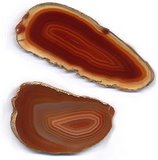
agate family
Agate jewelry
Agate is a banded variety of chalcedony, a microcrystalline form of quartz (SiO₂) prized for its concentric color layers and fibrous internal structure. The stone ranges from translucent white and gray to deep reds, browns, oranges, blues, and greens, with patterning that shifts between every specimen. Agate forms when silica-rich fluids fill cavities in volcanic rock, depositing thin layers over long periods. Its banded character separates it from compact chalcedony varieties like carnelian or chrysoprase.
Origin and Key Properties of Agate
The name traces to the Achates River (now the Dirillo) in Sicily, where Greek writer Theophrastus recorded the stone around 300 BCE. Major modern deposits are mined in Brazil, Uruguay, Mexico, India, Madagascar, Botswana, Germany (the historic Idar-Oberstein cutting center), and the United States — notably Oregon, Montana, and Lake Superior. Most commercial agate on the market today comes from Brazilian and Uruguayan basalt flows, where geodes the size of a fist up to several feet across are broken open and sliced.
Agate rates 6.5–7 on the Mohs scale and has a trigonal crystal system with a specific gravity near 2.60. It breaks with a conchoidal fracture, takes a high polish, and ranges from translucent to nearly opaque. Color is dictated by trace minerals: iron oxides produce the reds and browns seen in the reddish-brown banded slices pictured here, manganese contributes pinks, and chlorite or hornblende creates the dendritic patterns in moss agate.
Treatment disclosure matters. Because agate is porous, a large share of commercial material is dyed to deepen or shift color — bright blue, purple, green, and the hot pink "candy agate" found in tumbled sets are nearly always dyed. Heat treatment is also common, especially to darken pale Brazilian agate into carnelian-red tones. Natural-color material does exist (Botswana, Montana moss, Lake Superior, and most fortification agate) and typically commands higher prices.
Agate in Sterling Silver Jewelry
Agate is most often cut en cabochon to show off its banding, though flat polished slices, drilled beads, and free-form shapes are all standard. Faceting is rare since the stone's visual appeal lives in its patterning, not its refraction. Sterling silver (.925) pairs well with agate because the cool white metal lets the warm earth tones and banding read clearly without competing for attention, and silver is soft enough to bezel-set irregular cabochons securely. Our agate jewelry collection at SilverRush Style generally runs from about $25 for simple pendants and earrings up to roughly $150 for larger statement rings and cuffs.
When shopping, look at the bands under direct light — good cutting orients the pattern to center on the cabochon. Red and brown banded agates like the slices shown on this page work well in both everyday and dressier pieces, and their 7 hardness makes them durable enough for daily ring wear with reasonable care.
Care and Cleaning
Clean agate with warm water, mild soap, and a soft brush, then dry with a lint-free cloth. Skip ultrasonic and steam cleaners, which can damage dyed material and any internal fractures. Keep agate away from bleach, acetone, and household cleaners, and store pieces separately in a soft pouch so harder stones don't scratch the polish. Prolonged direct sunlight can fade dyed stones over time.
Frequently Asked Questions
Is agate a real gemstone?
Yes. Agate is a natural variety of chalcedony quartz with a Mohs hardness of 6.5–7, and it has been used in jewelry and carvings for over 3,000 years.
Is most agate dyed?
A significant portion is. Bright blues, purples, greens, and neon pinks are almost always dyed. Earth tones — reds, browns, whites, grays, and moss agate greens — are commonly natural, though red agate is sometimes heat-treated to intensify color.
Can I wear agate jewelry every day?
Agate holds up well to daily wear thanks to its 7 Mohs hardness. Remove rings before heavy manual work and avoid hard knocks, since the stone can chip on impact despite its scratch resistance.
How can I tell natural agate from dyed?
Examine the banding edges with magnification — dyed stones often show concentrated color along cracks and porous layers, while natural color sits evenly within each band. Unusually uniform, saturated colors at low prices are a strong dye indicator.
Talk to Our Jewelry Experts
Monday to Friday from 9AM to 5PM EST
