


 NECKLACES

 Shop now, pay later All Bracelets & Necklaces 96% OFF + All Rings 96% OFF
 Dichroic Glass
glass family
Dichroic Glass jewelry
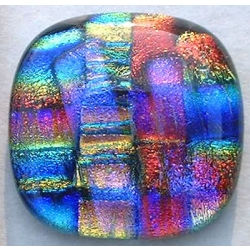
Dichroic Glass is a man-made art glass coated with ultra-thin layers of metal oxides that produce two or more distinct colors depending on viewing angle and light source. Unlike a natural mineral, Dichroic Glass is engineered — a base of borosilicate or soda-lime glass receives vacuum-deposited micro-layers of oxides such as titanium, silicon, magnesium, chromium, zirconium, and aluminum. The result is an opaque to semi-opaque material that shifts between metallic blues, reds, golds, greens, and violets, as shown in the cabochon on this page with its blue, red, and yellow shimmer.
Origin and Key Properties of Dichroic Glass
The optical effect has ancient precedent: the 4th-century Roman Lycurgus Cup shifts from green to red because of colloidal gold and silver nanoparticles in the glass. Modern Dichroic Glass came out of NASA and aerospace contractor research in the 1950s and 1960s, where thin-film coatings were developed for spacecraft visors and satellite mirrors. By the 1980s, manufacturers such as Coatings By Sandberg (CBS) in California and Austin Thin Films in Texas began producing sheets for studio glass artists, and most coated blanks used in jewelry today still originate in US coating facilities before being fused, slumped, and shaped by individual studios.
Hardness sits at roughly 5.5 on the Mohs scale, matching the soft-to-medium range of most fusing glass. Chemical composition varies by manufacturer but the substrate is typically soda-lime silicate (SiO₂ with Na₂O and CaO) or borosilicate (SiO₂ with B₂O₃); the dichroic layer itself is a stack of oxides 30–35 nanometers thick. The glass is opaque when backed with black or colored glass and translucent when fused clear. Specific gravity runs 2.4–2.6, and the refractive index of the coating layers is what produces the color split.
Treatment disclosure: Dichroic Glass is, by definition, treated — the coating is the product. Cabochons are usually kiln-fused in two or more layers (dichroic face plus clear or black cap), then cold-worked and polished. No dyes, irradiation, or fracture-filling are used. Each cabochon is unique because the coating breaks, pools, and reacts differently in every firing.
Dichroic Glass in Sterling Silver Jewelry
Cabochons are the standard cut — domed, oval, round, rectangular, or free-form — because the curved top surface maximizes the angle-dependent color shift. Faceted Dichroic Glass is rare; raw fused shards set in open bezels are occasionally used for pendants. Sterling silver (.925) is the preferred setting metal because its cool white tone stays neutral against the saturated coating colors and doesn't compete with the red-to-blue shift the way yellow gold would. Bezel settings protect the fused edge, which is the weakest point of any dichroic piece. At SilverRush Style, most dichroic glass jewelry — pendants, earrings, and rings — falls in the $20–$80 range, with larger statement pendants up to about $120.
Care and Cleaning
Clean with warm water, mild dish soap, and a soft cloth. Avoid ultrasonic cleaners, steam cleaners, bleach, and ammonia-based silver dips, which can etch the coating or damage the fused bond. Remove before swimming in chlorinated pools, showering, or applying perfume. Store each piece in a separate soft pouch; dichroic surfaces scratch against harder stones like quartz or topaz.
Frequently Asked Questions
Is dichroic glass a real gemstone?
No. Dichroic Glass is a man-made art glass with a metal-oxide coating, not a natural mineral. It is sold and set as a jewelry stone because of its optical behavior, but any reputable seller will describe it as glass.
What does "dichroic" mean?
The word comes from the Greek "di" (two) and "chroma" (color). A dichroic material shows two different colors depending on the angle of viewing or the type of light hitting it — reflected light produces one color, transmitted light another.
Why is dichroic glass expensive?
The coating process requires a vacuum chamber and crystalline metal oxides deposited in nanometer-thin layers. Raw coated sheets from US manufacturers run $150–$400 per square foot before the artist cuts, fuses, and finishes the cabochon.
Will the colors fade over time?
The coating is sealed under a fused clear or black glass cap, so the color layer is protected from air, moisture, and UV. Colors will not fade with normal wear. Surface scratches on the cap, however, will dull the optical effect, which is why ultrasonic cleaning and abrasive storage are the main risks.
Talk to Our Jewelry Experts
Monday to Friday from 9AM to 5PM EST
