

 NECKLACES

 Shop now, pay later All Bracelets & Necklaces 96% OFF + All Rings 96% OFF
 Pietersite
Pietersite jewelry
Pietersite is a brecciated aggregate of chatoyant amphibole fibers (primarily crocidolite and other hawk's eye-type minerals) cemented by quartz, recognized by its swirling blues, golds, and reddish-browns shot through with silky light play. Chemically it falls under the silicate group with a composition close to SiO₂ with embedded iron-rich amphibole fibers. The stone is opaque, takes a high polish, and is prized for the storm-like motion of its fibrous segments rather than the straight banding seen in tiger's eye. Collectors often call it the "tempest stone" because of that turbulent internal pattern.
Pietersite Origin and Key Properties
Pietersite was identified in 1962 by Sid Pieters while he was surveying farmland in the Kuibis region of Namibia, and the mineral was formally published in 1964 after registration with the British Museum. A second commercial deposit was found in Henan Province, China in 1993. These remain the only two viable sources, and the original Namibian deposit is effectively mined out, which has pushed prices for well-patterned Namibian material well above the Chinese grade. Namibian stones tend toward deeper blue and black matrix with red flashes; Chinese pietersite leans gold, caramel, and smoky blue.
On the Mohs scale, pietersite measures 6.5 to 7, close to quartz, which makes it durable enough for daily wear rings but still vulnerable to hard knocks and scratches from harder stones. The material is opaque with strong chatoyancy, and its silky fiber orientation is what gives each cabochon its directional shimmer. Color range covers midnight blue, steel gray, mustard and honey gold, rust red, and black, often appearing together in a single stone. Blue is the scarcest color, followed by red.
Treatments: most pietersite on the market is untreated. Some rough is stabilized with a clear resin or wax to firm up fractures before cutting, since the brecciated structure can be fragile. Dyeing is uncommon but does occur on lower-grade Chinese material to deepen blue tones. Reputable cutters disclose stabilization, and at SilverRush Style we list it when present.
Pietersite in Sterling Silver Jewelry
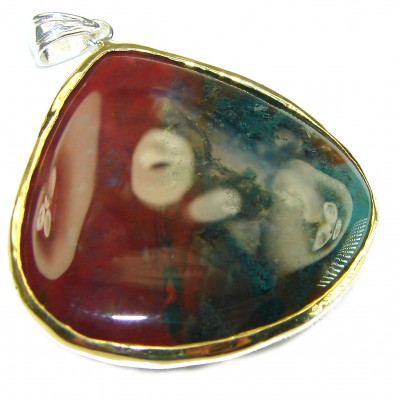
Pietersite is almost always cut as a cabochon, since faceting would kill the chatoyancy that gives the stone its value. Free-form cabs, ovals, and teardrops are the standard cuts, and high-grade pieces are oriented so the fiber flow reads across the face of the stone. Raw and slab pieces show up in statement pendants. Sterling silver (.925) is the natural setting metal for this material — the cool white tone sharpens the blues and keeps the gold swirls from looking muddy, which is what happens when warm yellow gold competes with the stone's own gold fibers. Bezel settings are most common because they protect the edges of the brecciated structure.
At SilverRush Style, our pietersite jewelry runs roughly $35 to $180 depending on size, pattern quality, and origin, with Namibian blue-dominant cabochons at the top of that range. Rings, pendants, and earrings are the most available formats; full bracelets and necklace strands are rarer because of the cost of matching colors across multiple stones.
Care and Cleaning
Clean pietersite with warm water, mild soap, and a soft cloth. Skip ultrasonic and steam cleaners — both can drive moisture into the brecciated fractures and loosen stabilization. Keep the stone away from bleach, chlorine, and acidic cleaners, and avoid long exposure to direct sunlight, which can fade the blue fibers over time. Store each piece in a separate soft pouch to prevent scratches from harder gems, and remove rings before lifting weights or gardening.
Frequently Asked Questions
Is pietersite a rare stone?
Yes. Only two deposits have ever produced commercial quantities — Namibia and China's Henan Province — and the Namibian source is largely depleted. Blue-dominant Namibian material is the scarcest grade.
What is the difference between pietersite and tiger's eye?
Both show chatoyancy from amphibole fibers in quartz, but tiger's eye has parallel, continuous banding. Pietersite is brecciated, meaning the fibers were broken and recemented, producing swirling multi-directional patterns and multiple colors in one stone.
Can pietersite get wet?
Brief contact with water during cleaning is fine. Avoid prolonged soaking, hot tubs, pools, and ocean water, since chlorine and salt can degrade any resin stabilization and seep into micro-fractures.
How can I tell if pietersite is real?
Real pietersite shows silky chatoyancy that shifts as you rotate the stone under a single light source, with irregular fiber directions rather than printed-looking patterns. Weight and hardness (6.5–7 Mohs) should match quartz. Resin fakes feel warm and light and show bubble inclusions under magnification.
Talk to Our Jewelry Experts
Monday to Friday from 9AM to 5PM EST
Recently Viewed