

 NECKLACES

 Shop now, pay later
Mystic Topaz
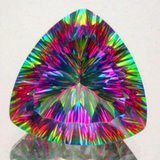
topaz family
Mystic Topaz jewelry
Mystic Topaz is colorless natural topaz (an aluminum silicate fluoride hydroxide, Al₂SiO₄(F,OH)₂) finished with a thin titanium-based coating that produces a rainbow play of green, blue, pink, and red across the crown. The base mineral belongs to the silicate class and shares the same hardness and clarity as plain white topaz; the coating supplies the multicolor effect, not the chemistry. Marketed under several trade names — Fire Topaz, Mystic Fire Topaz, Caribbean Topaz, Alaska Topaz, Alaskan Ice, and Rainbow Topaz — it is the same treated stone in every case. Cutters favor faceted shapes (round, oval, trillion, pear) because flat facets reflect the coating's spectral colors most efficiently.
Origin and Key Properties of Mystic Topaz
The colorless host topaz used for Mystic Topaz is mined chiefly in Minas Gerais, Brazil, with secondary supply from Sri Lanka, Nigeria, Pakistan, and Russia's Ural Mountains. Brazil's pegmatite deposits — particularly around Ouro Preto — have produced commercial-grade topaz since the 18th century and remain the dominant source of clean, colorless rough large enough for calibrated faceting. Most rough destined for Mystic treatment is cut first in Asia (India, Thailand, China) and then sent to coating facilities.
Topaz registers 8 on the Mohs scale, making it the fourth-hardest common gem material after diamond, corundum, and chrysoberyl. Specific gravity sits at 3.49–3.57, refractive index at 1.61–1.64, and the stone is transparent with vitreous luster. In its natural state topaz appears colorless, sherry yellow, brown, pale blue, pink, or rare imperial orange-red. The trade also sells heat-treated and irradiated blue topaz (Sky, Swiss, London), which is a different treatment from Mystic.
The Mystic finish is a physical vapor deposition (PVD) coating — typically titanium with trace metal oxides — applied to the pavilion (the back facets) of an already-cut stone. The film is microns thick and produces interference colors similar to those on coated camera lenses or oil on water. The coating is permanent under normal wear but can be scratched, scoured, or stripped by abrasives and harsh chemicals. Reputable sellers, including SilverRush Style, disclose the coating; any vendor calling Mystic Topaz "natural rainbow topaz" without qualification is misrepresenting it.
Mystic Topaz in Sterling Silver Jewelry
Faceted cuts dominate the Mystic Topaz market because the coating's color shift depends on light entering and exiting through angled facets — cabochons and raw crystals are uncommon and look comparatively flat. Trillion (triangular), round brilliant, oval, and pear cuts are standard. Sterling silver (.925) is the typical setting metal: its cool white tone reads as neutral against the green-pink-blue spectrum on the stone, and it costs less than white gold or platinum, which suits a coated gem rather than a high-investment piece. At SilverRush Style, mystic topaz jewelry generally runs $25–$120 for rings, pendants, and earrings, with larger statement rings reaching $150–$200.
Settings should protect the coated pavilion. Bezel and half-bezel mounts shield the back of the stone better than open-back prong settings, though prongs remain popular because they let light through. Avoid pieces where the pavilion sits flush against an abrasive surface.
Care and Cleaning
Clean Mystic Topaz with a soft cloth, lukewarm water, and mild dish soap. Do not use ultrasonic cleaners, steam cleaners, jewelry dips, ammonia, bleach, acetone, or abrasive polishing compounds — any of these can damage or remove the coating. Remove the piece before swimming, showering, applying lotion or perfume, and doing housework. Store separately in a soft pouch; topaz at hardness 8 will scratch softer stones, and harder materials (or grit) will scratch the coated surface.
Frequently Asked Questions
Is Mystic Topaz a real gemstone?
Yes. The base stone is genuine natural topaz, the same mineral as colorless, blue, or imperial topaz. The rainbow effect comes from a thin titanium coating applied after cutting, so the gem itself is real but the color is a treatment, not a natural property.
What does Mystic Topaz mean or symbolize?
Because the coating produces multiple colors at once, Mystic Topaz is associated in metaphysical traditions with transformation, balance across the chakras, and personal change. Topaz itself has historically been linked to clarity of thought and protection. These are cultural meanings, not measurable properties.
Does the rainbow color fade or wear off?
The PVD coating is permanent under ordinary wear, but it can be scratched off the pavilion by abrasion or stripped by ultrasonic cleaning, steam, harsh solvents, or jewelry dips. With careful handling and hand cleaning, the color holds for many years.
What is the difference between Mystic Topaz and Caribbean Topaz?
None — they are trade names for the same product. Caribbean Topaz, Alaska Topaz, Alaskan Ice, Mystic Fire Topaz, and Rainbow Topaz all refer to colorless natural topaz with a titanium vapor-deposition coating.
Talk to Our Jewelry Experts
Monday to Friday from 9AM to 5PM EST
Recently Viewed