


 NECKLACES

 Shop now, pay later
Blue Topaz
Topaz family
Blue Topaz jewelry
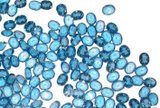
Blue Topaz is a silicate mineral from the topaz family, colored in shades ranging from pale sky blue ("Sky Blue") through medium "Swiss Blue" to deep, saturated "London Blue." Chemically it is aluminum fluorosilicate, Al₂SiO₄(F,OH)₂, prized for its glassy luster and clean transparency. Nearly all commercial Blue Topaz on the market starts as colorless rough that is treated to produce its blue hue. It is the state gemstone of Texas and one of the most widely worn blue stones in fine jewelry.
Origin and Key Properties of Blue Topaz
Topaz forms in pegmatite veins and rhyolitic lava flows where fluorine-rich vapors meet granitic rock. The largest modern producer is Brazil, particularly Minas Gerais, which supplies most of the colorless rough used for blue material. Additional commercial deposits are mined in Nigeria, Sri Lanka, Pakistan, Russia (the Ural Mountains and the Volyn region), Madagascar, and the Thomas Range in Utah. Naturally blue topaz does occur — notably at St. Anne's Mine in Zimbabwe and in Texas's Mason County — but natural stones tend to be pale and are uncommon in jewelry-grade sizes.
Topaz measures 8 on the Mohs scale, placing it just below corundum and well above quartz, though it has perfect basal cleavage that requires care against sharp blows. The stone is transparent to translucent with a refractive index of 1.61–1.64 and a specific gravity near 3.53. Color grades sold in the trade include Sky Blue (light, slightly greenish blue), Swiss Blue (bright medium blue), and London Blue (deep steely blue with a faint gray cast).
Treatment disclosure matters here: almost all Blue Topaz is irradiated and then heat-treated to stabilize the color. Colorless rough is exposed to gamma rays, electrons, or neutrons in a linear accelerator or reactor, producing brown topaz that is then heated to reveal the blue. The color is considered permanent and the stones are held in quarantine until residual radioactivity decays to safe levels before export, per US NRC rules.
Blue Topaz in Sterling Silver Jewelry
Because Blue Topaz is clean and takes a sharp polish, it is cut primarily as faceted stones — ovals, rounds, pears, cushions, and emerald cuts are standard, with concave and checkerboard cuts used to add brilliance in larger sizes. Cabochons and rough crystal slices show up in artisan pieces but are less common. Sterling silver (.925) is a practical setting metal for this stone: the cool white tone of silver reinforces the icy blue of Sky and Swiss grades, while oxidized silver deepens the contrast on London Blue. At SilverRush Style most blue topaz jewelry — rings, pendants, earrings, and bracelets — falls in the $30 to $180 range depending on carat weight, cut complexity, and setting.
Larger center stones (8x10mm and up) are widely available because the rough is plentiful, so shoppers can find statement rings and pendants at prices well below those of sapphire or aquamarine in comparable sizes. Pair Swiss Blue with polished silver for a crisp look; choose London Blue with marcasite or antiqued silver for something closer to a vintage feel.
Care and Cleaning
Clean Blue Topaz with warm water, mild dish soap, and a soft brush. Avoid ultrasonic and steam cleaners — the cleavage plane makes the stone vulnerable to vibration and thermal shock. Keep it out of prolonged direct sunlight, since extended UV exposure can fade the color in some treated stones, and store each piece in a separate pouch to prevent scratches from harder gems.
Frequently Asked Questions
Is Blue Topaz a real gemstone?
Yes. Blue Topaz is natural topaz, a genuine aluminum fluorosilicate mineral. The rough is mined from the earth, most commonly in Brazil, then irradiated and heated to develop the blue color. It is not synthetic or lab-grown.
What is the difference between Sky, Swiss, and London Blue Topaz?
The three names refer to color grades produced by different irradiation and heating protocols. Sky Blue is the lightest, resembling aquamarine. Swiss Blue is a bright, medium saturation blue. London Blue is the darkest, with a deep inky tone and slight gray undertone.
Is irradiated Blue Topaz safe to wear?
Yes. In the United States, irradiated topaz must be held by the distributor until residual radioactivity falls below limits set by the Nuclear Regulatory Commission. By the time the stones reach retail, they measure at or below natural background radiation.
What is the birthstone month for Blue Topaz?
Blue Topaz is one of the modern December birthstones, alongside turquoise, tanzanite, and zircon. It is also the traditional gift for the 4th wedding anniversary.
Talk to Our Jewelry Experts
Monday to Friday from 9AM to 5PM EST
