

 NECKLACES

 Shop now, pay later All Bracelets & Necklaces & Earrings 96% OFF + Other 95% OFF
 Mother of Pearl
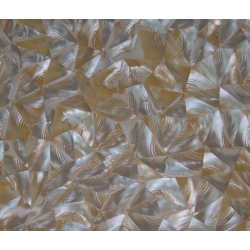
pearl family
Mother of Pearl jewelry
Mother of Pearl is the iridescent inner shell layer produced by pearl oysters, abalone, and freshwater mussels — the same biomineral, called nacre, that coats a pearl. Chemically it is a composite of aragonite (calcium carbonate) platelets bound by the protein conchiolin, giving it a layered structure that diffracts light into soft whites, silvers, creams, and pale pinks. Because it comes from a living mollusk, it belongs to the organic gem group alongside amber, coral, and jet.
Origin and Key Properties of Mother of Pearl
Commercial nacre comes from several species across distinct regions. The silver-lipped and gold-lipped oysters (Pinctada maxima) are farmed in Australia, Indonesia, and the Philippines. Black-lip oyster (Pinctada margaritifera) nacre comes from French Polynesia and the Cook Islands. Abalone (Paua) shell, with its stronger blue-green flash, is harvested in New Zealand and along the California coast. Freshwater mussel nacre is sourced from the Mississippi River basin and from farms in China, which now supplies the majority of white Mother of Pearl used in jewelry inlay.
On the Mohs scale, Mother of Pearl rates 2.5 to 4.5, which is soft compared to quartz or beryl. It is opaque to slightly translucent with a pearly to silky luster. Natural color range runs from white and cream through gray, yellow, pink, and the near-black of Tahitian shell. The iridescence, called orient, is an optical effect from the stacked aragonite platelets, each under half a micrometer thick.
Treatments are common and should be disclosed. White Mother of Pearl is often bleached to even out color. Dyeing produces the pink, blue, green, and black shades seen in budget jewelry — these dyes sit between the nacre layers and can fade with prolonged sun exposure. Some material is stabilized with clear resin to reduce chipping during cutting. Reconstituted or "mosaic" Mother of Pearl uses shell fragments bonded with resin; this is still real nacre but should not be sold as solid shell.
Mother of Pearl in Sterling Silver Jewelry
Mother of Pearl is almost always cut as a cabochon, flat inlay, or carved shape rather than faceted, because the layered structure scatters light better across a smooth dome than through cut facets. You will also see it carved into cameos, doves, crosses, and floral motifs, or laser-cut into geometric inlays. The soft white of sterling silver (.925) matches the cool reflective quality of the nacre without competing with it, while silver's slight gray tone lets the iridescent flashes read as the focal point.
At SilverRush Style, most mother of pearl jewelry falls in the $25 to $90 range for rings, pendants, and earrings, with larger statement pieces and multi-stone designs running higher. Because the material is affordable and takes shape well, it suits everything from minimal stud earrings to Art Nouveau-style pendants.
Care and Cleaning
Wipe Mother of Pearl with a soft damp cloth and dry immediately. Avoid ultrasonic cleaners, steam, ammonia, bleach, and acidic household cleaners — all will dissolve or dull the nacre surface. Keep it away from perfume, hairspray, and chlorine. Store pieces in a soft pouch, separate from harder stones, and put jewelry on last when getting dressed.
Frequently Asked Questions
Is Mother of Pearl the same as a pearl?
Both are nacre produced by the same mollusks. A pearl forms in layers around an irritant inside the animal, while Mother of Pearl is the nacreous lining of the shell itself. Chemically they are identical; the difference is shape and how the animal deposited the material.
Is Mother of Pearl a real gemstone?
It is classified as an organic gem, meaning it comes from a living source rather than being mined as a mineral. It has been used in jewelry, inlay, and decorative objects for more than 5,000 years, with documented use in ancient Egypt and Mesopotamia.
Can Mother of Pearl get wet?
Brief contact with fresh water is fine, but remove it before swimming, showering, or washing dishes. Chlorine, salt water, and soaps degrade the surface over time and can lift dye from treated pieces.
What does Mother of Pearl symbolize?
Across cultures it has been linked to motherhood, protection, and intuition. In metaphysical practice it is associated with calm and emotional balance. These are traditional meanings, not scientific claims.
Talk to Our Jewelry Experts
Monday to Friday from 9AM to 5PM EST
Recently Viewed