


 NECKLACES

 Shop now, pay later
Malachite
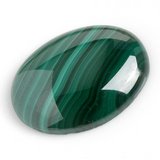
Malachite jewelry
Malachite is a green copper carbonate mineral (Cu₂CO₃(OH)₂) prized for its banded light-and-dark green patterns that form as concentric rings, swirls, or botryoidal knobs. It belongs to the monoclinic crystal system and forms as a secondary mineral in the oxidation zones of copper deposits, typically alongside azurite. The stone is fully opaque, with color ranging from pale mint to deep forest green, and it takes a high polish that brings out its signature swirling bands.
Origin and Key Properties of Malachite
The Democratic Republic of the Congo produces the bulk of today's gem-grade malachite, with the Kolwezi and Katanga copper belts yielding large botryoidal masses with sharp banding. Other significant sources include Russia's Ural Mountains (historically the source for the malachite columns in St. Isaac's Cathedral and the Hermitage's Malachite Room), Australia, Namibia, Mexico, Zambia, and the Timna Valley in Israel. Arizona's Morenci and Bisbee mines have also produced notable material as a copper-mining byproduct.
Malachite rates 3.5 to 4 on the Mohs scale, making it a soft stone that requires careful wear. Its specific gravity runs high at 3.6 to 4.0 due to the copper content, so finished pieces feel dense for their size. The chemical formula Cu₂CO₃(OH)₂ means the stone reacts with acids — including vinegar, lemon juice, and even prolonged sweat exposure — which can etch the polish and dull the surface.
Stabilization is the most common treatment: porous or fragile specimens are impregnated with clear resin or wax to strengthen the stone and deepen the polish. Reconstituted malachite (ground powder bonded with resin) exists on the market and should be disclosed. Dyeing is rare since the natural green needs no enhancement. All malachite sold at SilverRush Style is natural stone; any stabilization is noted in the product listing.
Malachite in Sterling Silver Jewelry
Because malachite is opaque with pattern rather than brilliance, it is almost always cut as cabochons — oval, round, teardrop, or freeform domes that showcase the banding. Flat slabs are used for inlay work and statement pendants, and tumbled or carved pieces appear in bohemian and tribal-style designs. Faceting is uncommon and generally not worth the effort since light does not pass through the stone. Sterling silver (.925) is the preferred metal partner: the cool white tone of silver sharpens the green bands without competing for attention, and oxidized silver settings add depth to the darker green rings. Our malachite jewelry collection spans rings, pendants, earrings, and bracelets, with most pieces priced between $25 and $120 depending on stone size and setting complexity.
When shopping, look for sharp contrast between the light and dark bands, a glass-like polish, and settings that protect the stone's edges. Bezel settings work better than prongs for daily wear, since they shield the soft stone from knocks.
Care and Cleaning
Clean malachite with a soft cloth dampened in plain lukewarm water and dry immediately. Avoid ultrasonic cleaners, steam cleaners, ammonia, acids, household cleaners, and hot soapy water — all can damage the surface or dissolve copper compounds. Remove malachite jewelry before swimming, showering, exercising, or applying lotions and perfumes. Store pieces separately in a soft pouch, away from harder gems that could scratch them, and keep out of prolonged direct sunlight to prevent fading.
Frequently Asked Questions
Is malachite a real gemstone or manmade?
Natural malachite is a real mineral that forms in copper deposits over millions of years. Reconstituted malachite — ground stone bonded with resin — also exists and must be disclosed by reputable sellers. SilverRush Style sells only natural malachite.
Can malachite get wet?
Brief contact with plain water is fine for cleaning, but malachite should not be soaked or worn in showers, pools, or hot tubs. The stone reacts with acids and chlorinated water, which can etch the polish and damage the copper mineral structure.
How hard is malachite?
Malachite rates 3.5 to 4 on the Mohs scale, which is softer than quartz (7) or most jewelry stones. It scratches easily and is best set in protective bezels for rings and bracelets that see daily wear.
Where does the best malachite come from?
The Democratic Republic of the Congo is the leading source of gem-grade malachite today, producing large botryoidal masses with strong banding contrast. Historical Russian Ural material is considered top-tier but is largely depleted.
Talk to Our Jewelry Experts
Monday to Friday from 9AM to 5PM EST
