


 NECKLACES

 Shop now, pay later
Amethyst
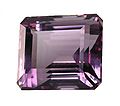
amethyst family
Amethyst jewelry
Amethyst is the purple variety of quartz, a silicon dioxide (SiO₂) mineral that ranges from pale lilac to deep reddish-violet. Its color comes from trace iron impurities and natural gamma irradiation within the crystal lattice. Long associated with sobriety and clear thinking in Greek tradition, Amethyst remains one of the most widely set colored stones in sterling silver jewelry. The specimen shown here is a transparent, square step-cut with the saturated violet tone collectors call "Siberian" grade.
Origin and Key Properties of Amethyst
The largest commercial deposits are found in Brazil (Rio Grande do Sul and Bahia) and Uruguay (Artigas), where geodes form in basalt cavities. Uruguayan material is prized for its deeper, more saturated color, while Brazilian stones tend toward lighter lavender. Other significant sources include Zambia (Kariba mine), Madagascar, Russia's Ural Mountains (the historic "Siberian" source), and Arizona's Four Peaks mine in the United States.
Amethyst rates 7 on the Mohs hardness scale, making it durable enough for daily wear in rings, though still softer than sapphire or topaz. It shows vitreous luster, trigonal crystal structure, and transparent to translucent clarity. Color zoning is common — many rough crystals display alternating bands of purple and colorless quartz, which cutters orient carefully to concentrate color in the table of the finished stone. Amethyst is also weakly dichroic, shifting between bluish-purple and reddish-purple as the viewing angle changes.
Most Amethyst on the market is untreated, which sets it apart from many colored gems. However, heat treatment at 470–750°C converts Amethyst to yellow or orange citrine, and some pale material is irradiated to deepen color. Prolonged exposure to direct sunlight can fade natural Amethyst over months or years, so the stone is best stored away from windows.
Amethyst in Sterling Silver Jewelry
Amethyst takes well to faceted cuts — oval, cushion, emerald, and round brilliant are standard — because its transparency rewards precision faceting with strong light return. Cabochons are used for lower-clarity material or for designers who want a softer, domed look. Raw and geode-slice Amethyst has become popular in statement pendants. The cool tone of sterling silver (.925) sharpens the violet hue without the warm cast that yellow gold adds, which is why most purple quartz ends up in silver mountings. At SilverRush Style, our amethyst jewelry typically runs $25 to $150, depending on stone size and setting complexity.
February's birthstone and the traditional gift for a sixth wedding anniversary, Amethyst pairs well with pearl, peridot, and topaz in multi-stone designs. Larger calibrated stones (10mm+) remain affordable compared to other transparent purple gems like sapphire or tanzanite, making Amethyst a practical choice for cocktail rings and pendants where visual impact matters.
Care and Cleaning
Clean Amethyst with warm water, mild dish soap, and a soft brush. Avoid ultrasonic and steam cleaners on stones with visible inclusions or fractures, and keep Amethyst away from bleach, acetone, and chlorinated pool water — these can damage silver settings even when the stone itself is safe. Store separately in a soft pouch away from direct sunlight to prevent color fade, and keep harder stones (diamond, sapphire, topaz) in separate compartments to avoid scratches.
Frequently Asked Questions
Is Amethyst a real gemstone or synthetic?
Natural Amethyst is mined from volcanic rock deposits in Brazil, Uruguay, Zambia, and elsewhere. Synthetic (hydrothermal) Amethyst also exists and is chemically identical, but natural material dominates the jewelry market because it is abundant and affordable. SilverRush Style sets only natural Amethyst.
Can Amethyst be worn every day?
Yes. At Mohs 7, Amethyst handles daily wear in pendants, earrings, and bracelets. For rings worn constantly, remove the piece during heavy manual work to prevent chipping along facet edges.
Why does Amethyst vary so much in color?
Color depends on the concentration of iron impurities and the amount of natural radiation the crystal absorbed during formation. Deeper purple stones from Uruguay and Zambia command higher prices than pale Brazilian material, though personal preference drives much of the market.
Will Amethyst fade over time?
Prolonged direct sunlight can lighten Amethyst, particularly stones with lower iron content. Store jewelry in a drawer or pouch when not worn, and avoid leaving pieces on sunny windowsills.
Talk to Our Jewelry Experts
Monday to Friday from 9AM to 5PM EST
