

 NECKLACES

 Shop now, pay later
Tourmaline
Tourmaline jewelry
Tourmaline is a boron silicate mineral group prized for having the widest color range of any gemstone, with crystals growing in pink, green, blue, yellow, red, black, and bicolor or tricolor combinations within a single stone. The name traces to the Sinhalese "thuramali," a term Sri Lankan traders used for mixed parcels of colored gems shipped to Europe by the Dutch East India Company in the early 1700s. Because tourmaline refers to a family of related species (elbaite, schorl, dravite, liddicoatite, and others) rather than a single mineral, chemistry and color shift from one deposit to the next.
Tourmaline Origin and Key Properties
Brazil has been the dominant source since the 1500s, with Minas Gerais producing the pink, green, and watermelon elbaite most shoppers recognize. The Paraíba deposit discovered in 1989 added a copper-bearing neon blue-green variety now also mined in Mozambique and Nigeria. Other major producers include Afghanistan, Pakistan, Madagascar, Sri Lanka, and the United States — Maine (Mount Mica) and California (Himalaya Mine) have commercial deposits, though US production is small compared to African and South American output.
Tourmaline rates 7 to 7.5 on the Mohs scale, making it hard enough for daily wear rings with reasonable care. The general chemical formula is (Ca,K,Na,[ ])(Al,Fe,Li,Mg,Mn)3(Al,Cr,Fe,V)6(BO3)3Si6O18(OH,F)4. Most gem tourmaline is transparent; opaque black schorl is common in mineral specimens and men's jewelry. Refractive index runs 1.614 to 1.666, and the crystal system is trigonal, which produces the elongated, three-sided prisms seen in rough specimens like the pink-green-yellow crystal shown here.
Treatment disclosure: heat treatment is routine for tourmaline, typically at 500–650°C, to lighten overly dark green and blue stones or improve pink and red hues. Irradiation is also used on pink and red material. Both treatments are stable and permanent. Clarity enhancement by fracture filling exists but is less common — if a stone has been filled, it should be disclosed at the point of sale.
Tourmaline in Sterling Silver Jewelry
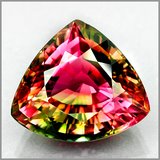
Faceted cuts dominate in fine tourmaline jewelry because the stone's pleochroism (showing different colors along different crystal axes) rewards careful orientation by the cutter. Emerald cuts, ovals, and cushions are standard for pink and green material; rose cuts and slices show off bicolor and watermelon patterns. Cabochons appear in cat's-eye tourmaline and in lower-clarity rough, while raw crystal sections work well in pendants where the natural prism shape stays visible.
Sterling silver (.925) suits tourmaline for two reasons: the cool white metal reads as neutral against the stone's saturated colors rather than competing with them, and silver's density and price let jewelers use larger stones than gold settings typically allow at the same budget. At SilverRush Style, our tourmaline jewelry generally runs $40 to $250 depending on carat weight, color grade, and setting complexity, with pink and green elbaite the most available and Paraíba-type material reserved for accent stones.
Care and Cleaning
Clean tourmaline with warm water, mild dish soap, and a soft brush. Skip ultrasonic and steam cleaners — thermal shock and vibration can widen internal fractures, which tourmaline often has. Avoid prolonged sun exposure for heated pink stones, as color can fade over years of constant UV. Store pieces separately in a soft pouch so harder gems (sapphire, topaz, quartz) don't scratch the surface.
Frequently Asked Questions
What does tourmaline stone look like?
In rough form, tourmaline grows as elongated three-sided prisms with vertical striations running along the crystal. Cut stones are typically transparent and come in nearly every color, including bicolor "watermelon" tourmaline with a pink core and green rim. Black schorl is opaque and glassy.
Is tourmaline a real gemstone?
Yes. Tourmaline is a natural mineral group mined commercially for over 500 years. It serves as an October birthstone alongside opal and is graded by the same color, clarity, cut, and carat standards as other colored gems.
How hard is tourmaline compared to other gems?
Tourmaline is 7 to 7.5 on the Mohs scale, harder than opal (5.5–6.5) and peridot (6.5–7) but softer than sapphire (9) and topaz (8). It works well in earrings, pendants, and occasional-wear rings; everyday rings benefit from protective bezel or halo settings.
What is the most valuable color of tourmaline?
Paraíba tourmaline — copper-bearing stones in neon blue, turquoise, or green — commands the highest prices, sometimes over $10,000 per carat for top Brazilian material. Chrome tourmaline (intense green) and rubellite (saturated red-pink) rank next. Standard pink and mint green run from $50 to a few hundred dollars per carat.
Talk to Our Jewelry Experts
Monday to Friday from 9AM to 5PM EST
Recently Viewed