


 NECKLACES

 Shop now, pay later
Tiger's Eye
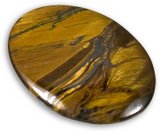
Tiger's Eye is a chatoyant variety of quartz (SiO₂) recognized by its golden-brown to reddish bands and silky fibrous sheen that shifts as the stone moves under light. The specimen shown here displays the classic yellow-brown body color with darker banding, cut en cabochon to bring out the cat's-eye reflection. It belongs to the cryptocrystalline quartz group and forms through a crack-seal vein-filling process where quartz and crocidolite fibers grow together, producing the parallel fiber structure responsible for the optical effect.
Origin and Key Properties of Tiger's Eye
The most productive Tiger's Eye deposits lie in the Northern Cape Province of South Africa, particularly the Asbestos Mountains near Griquatown, which has supplied the global market since the 19th century. Additional sources include Western Australia (Hamersley Range), Namibia, India (Andhra Pradesh), Brazil, Canada, China, and the United States (California). South African material is generally considered the benchmark for color saturation and fiber clarity.
Tiger's Eye rates 6.5 to 7 on the Mohs scale, with a specific gravity around 2.64–2.71 and a refractive index of 1.544–1.553. It is opaque to translucent. Standard colors run from honey-yellow through golden brown to deep red-brown; the bluish-gray incompletely silicified variant is sold as Hawk's Eye, and the green-gray banded form is Pietersite's cousin, not to be confused with serpentine.
Two treatments are common and should be disclosed at point of sale. Heat treatment at moderate temperatures converts yellow-brown Tiger's Eye to the oxidized red variety known as ox-eye or bull's-eye; this is stable and permanent. Acid bleaching produces lighter honey tones. Dyeing to blue, green, or purple is also seen on low-grade rough. Untreated golden and brown material is widely available, and all Tiger's Eye sold by SilverRush Style is natural color unless noted otherwise.
Tiger's Eye in Sterling Silver Jewelry
Cabochon is the dominant cut because it maximizes chatoyancy — the single moving light band that defines the stone. Ovals, rounds, and rectangular cushions are standard; faceted Tiger's Eye exists but is uncommon because faceting breaks up the silky reflection. Raw and tumbled pieces appear in bead strands and wire-wrapped pendants. The warm yellow-to-red palette sits well against the cool white of sterling silver (.925), and the contrast sharpens the chatoyant line without competing with it.
At SilverRush Style, tiger's eye jewelry typically runs from about $25 for simple stud earrings and rings up to $120–$180 for larger statement pendants and cuff bracelets. Bead necklaces fall in the middle of that range depending on length and the amount of silver hardware.
Care and Cleaning
Clean Tiger's Eye with warm water, mild soap, and a soft cloth or soft-bristle brush. Skip ultrasonic and steam cleaners — the fibrous internal structure can react badly to vibration and heat shock. Keep the stone away from bleach, acetone, and chlorinated pool water. Store pieces separately in a soft pouch to protect the polished dome from scratches caused by harder gems, and remove rings before heavy lifting or gardening.
Frequently Asked Questions
Is Tiger's Eye a real gemstone?
Yes. Tiger's Eye is a natural silicate mineral — a fibrous variety of quartz — that has been mined and worn as an ornamental gem for over a century. It is not synthetic or reconstituted when sourced from established deposits in South Africa, Australia, or Namibia.
Can Tiger's Eye be worn every day?
At 6.5–7 Mohs it holds up to daily wear in pendants, earrings, and bracelets. Rings see more impact, so choose bezel-set designs and avoid knocks against hard surfaces. Remove jewelry before cleaning with household chemicals.
Why does Tiger's Eye shimmer?
The effect is called chatoyancy. Parallel fibers of quartz (and relic crocidolite) reflect light as a single moving band across the curved surface of a cabochon, producing the cat's-eye appearance that gives the stone its name.
What is the difference between Tiger's Eye and Hawk's Eye?
Both come from the same rock. Hawk's Eye is the blue-gray form where the original crocidolite fibers have not been fully replaced by silica. When oxidation and silicification complete, iron in the crocidolite turns golden-brown and the material becomes Tiger's Eye.
Talk to Our Jewelry Experts
Monday to Friday from 9AM to 5PM EST
