


 NECKLACES

 Shop now, pay later
Sodalite
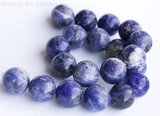
Sodalite jewelry
Sodalite is a rich royal-blue silicate mineral belonging to the feldspathoid group, with a chemical composition of Na₈(Al₆Si₆O₂₄)Cl₂. The stone takes its name from its high sodium content and is recognized by white veining of calcite running through a deep blue body. While most material reaches the market as opaque ornamental rough, rare crystals can be transparent to translucent.
Origin and Key Properties of Sodalite
Sodalite was first identified in Greenland in 1806, but it remained a mineralogical curiosity until 1891, when large gem-quality deposits were uncovered at Princess Sodalite Mine in Bancroft, Ontario, Canada. Today, commercial sodalite comes primarily from Brazil (Bahia), Namibia (Swartbooisdrif), Bolivia, India, and Russia, with Canadian and Brazilian material prized for its saturated blue color. The mineral forms in silica-poor igneous rocks such as nepheline syenite and phonolite.
On the Mohs scale, sodalite measures 5.5 to 6, softer than quartz and requiring more care than agate or jasper. It has a specific gravity of 2.27–2.33, a vitreous to greasy luster, and shows perfect cleavage in one direction, which makes it more fragile than its hardness suggests. Color ranges from royal blue and indigo to gray, green, yellow, and pink (the pink variety is called hackmanite, which can be tenebrescent and shift color under UV light).
Most sodalite sold for jewelry is untreated. Color is natural, and the white markings are calcite or natrolite inclusions. Some lower-grade material may be wax-impregnated or sealed to improve polish and protect the surface, and dyeing is occasionally seen on pale stones to deepen the blue. Reputable suppliers disclose any enhancement.
Sodalite in Sterling Silver Jewelry
Sodalite is almost always cut as cabochons, beads, or tumbled freeforms, since the opaque body and calcite veining show best on a smooth dome rather than facets. Larger slabs are used for statement pendants and bold rings, while round and oval cabs work well in earrings and bracelets. The cool blue tone pairs naturally with the white luster of sterling silver (.925), and the contrast keeps the calcite veining visible. Our sodalite jewelry typically falls in the $25–$120 range, with most rings and pendants between $35 and $80.
Because sodalite reads as a deep, saturated blue with quiet white movement, it suits both casual everyday wear and dressier looks. Sterling silver settings give the stone a clean frame without competing for attention, and the metal won't pull warm tones into the blue the way yellow gold can.
Care and Cleaning
Clean sodalite with warm water, mild soap, and a soft cloth or toothbrush. Avoid ultrasonic and steam cleaners, which can crack the stone along its cleavage planes, and keep it away from bleach, ammonia, and acidic cleaners. Prolonged sun exposure may fade some material, especially hackmanite. Store sodalite separately in a soft pouch to prevent harder gems like quartz or topaz from scratching it.
Frequently Asked Questions
How hard is sodalite?
Sodalite measures 5.5 to 6 on the Mohs scale. It is softer than quartz and has perfect cleavage in one direction, so it can chip if dropped or struck against a hard surface.
How is sodalite formed?
Sodalite forms in silica-poor igneous rocks such as nepheline syenite, phonolite, and trachyte, where sodium-rich magma cools and crystallizes. It also occurs in metamorphosed limestones that have reacted with sodium-bearing fluids.
Is sodalite a real gemstone?
Yes. Sodalite is a recognized natural gemstone used in jewelry since the late 1800s. It is most often cut as cabochons and beads, and is sometimes confused with lapis lazuli, which actually contains sodalite as one of its components along with lazurite, hauyne, and nosean.
What is the difference between sodalite and lapis lazuli?
Lapis lazuli is a rock made up of several minerals including lazurite, calcite, pyrite, and sodalite. Sodalite is a single mineral. Lapis usually shows gold pyrite flecks, while sodalite shows white calcite veining and tends toward a more uniform royal blue.
Talk to Our Jewelry Experts
Monday to Friday from 9AM to 5PM EST
