


 NECKLACES

 Shop now, pay later All Bracelets & Necklaces 96% OFF + All Rings 96% OFF
 Shell
Shell jewelry
Shell is an organic gem material formed by mollusks — clams, oysters, abalone, conch, and nautilus — rather than a true mineral. It consists primarily of calcium carbonate (CaCO₃) in aragonite or calcite form, bonded by an organic protein called conchiolin. Colors range from chalk white, cream, and beige through pink, orange, brown, and the iridescent blue-green-violet sheen of mother-of-pearl, depending on the species and the layer used.
Shell Origin and Key Properties
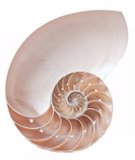
Shell used in jewelry comes from commercial fisheries and farms worldwide. Mother-of-pearl and pen shell originate mainly from the Indo-Pacific (Philippines, Indonesia, Australia); queen conch comes from the Caribbean (Bahamas, Turks and Caicos); abalone (paua) is harvested off New Zealand, California, and South Africa; cameo shell (Cassis) is worked primarily in Torre del Greco, Italy, a tradition dating to the early 1800s. Nautilus shell, like the specimen shown on this page, is sourced from the tropical western Pacific.
Structurally, a shell has three layers: an outer periostracum of conchiolin, a middle prismatic calcium carbonate layer, and an inner nacreous layer where platelets of aragonite produce iridescence. Hardness sits at 3.5–4 on the Mohs scale, with specific gravity around 2.85 and a refractive index of 1.53–1.68. Shell is opaque to translucent with a waxy to pearly luster. Because it is relatively soft and contains organic material, it is more fragile than quartz or agate and sensitive to acids.
Treatments are common and should be disclosed. White and pink shell is often bleached to even out color. Dyed shell — particularly black "mother-of-pearl" and bright blue or green abalone imitations — is widespread; reconstituted or resin-bonded shell chips are also sold as beads. Untreated nautilus, natural abalone, and natural pink conch retain their color without enhancement.
Shell in Sterling Silver Jewelry
Because shell cannot be faceted, it is cut as cabochons, flat inlay pieces, carved cameos, tumbled chips, or drilled beads. Mother-of-pearl is frequently cut into discs, hearts, and crosses for pendants; abalone works well as inlay in rings and cuffs; conch and helmet shell are carved into cameos. Sterling silver (.925) is a practical setting metal for shell: the neutral white tone does not compete with the nacre's iridescence, and bezels protect the soft edges better than prong settings.
At SilverRush Style, most shell jewelry falls between $15 and $80, with larger carved or inlay pieces reaching around $120. Browse pendants, earrings, and rings set in solid .925 sterling silver.
Care and Cleaning
Clean shell with a soft cloth dampened in warm water and mild soap, then dry immediately. Avoid ultrasonic and steam cleaners, acidic cleaners, perfume, hairspray, and chlorinated water — all of which dull the surface or etch the calcium carbonate. Keep shell away from prolonged direct sunlight, which can fade dyed pieces. Store separately in a soft pouch so harder gems do not scratch it.
Frequently Asked Questions
Is shell a real gemstone?
Shell is classified as an organic gem, the same category as pearl, amber, coral, and jet. It is not a mineral because it is produced by a living animal, but it has been used in jewelry for at least 40,000 years and is recognized by the GIA as a gem material.
What is the difference between shell and mother-of-pearl?
Mother-of-pearl is specifically the nacreous inner layer of certain shells, the same iridescent substance that coats a pearl. "Shell" is the broader term covering the entire structure, including non-iridescent outer layers used for cameos and carvings.
Can shell jewelry get wet?
Brief contact with fresh water is fine, but remove shell jewelry before swimming, showering, or washing dishes. Chlorine, salt water, and soap residue dull the nacre over time, and the sterling silver setting will tarnish faster with repeated exposure.
How can I tell if shell is dyed?
Dyed shell often shows color concentrated in drill holes, cracks, or along edges, and the hue may look unusually saturated or uniform. Natural abalone has a mottled, shifting iridescence; natural pink conch shows a flame-like structure. Reputable sellers disclose dye treatment in the listing.
Talk to Our Jewelry Experts
Monday to Friday from 9AM to 5PM EST
