


 NECKLACES

 Shop now, pay later
Seraphinite
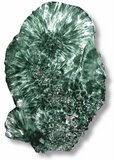
Seraphinite jewelry
Seraphinite is a trade name for a chatoyant, gem-quality variety of clinochlore, a magnesium-iron phyllosilicate in the chlorite mineral group. The stone shows deep forest-green to nearly black body color crossed by silvery, feather-like fibrous patterns that give it its angelic nickname. Its chemistry is approximately (Mg,Fe)₅Al(Si₃Al)O₁₀(OH)₈, and it is always opaque, never transparent.
Seraphinite Origin and Key Properties
Gem-grade Seraphinite comes from a single commercial source: the Korshunovskoye iron-ore deposit in the Lake Baikal region of Eastern Siberia, Russia. It was first described in the 19th century by Russian mineralogist Nikolai Koksharov, who documented clinochlore specimens from the Urals. The Siberian material reached the lapidary market in the late 20th century, and no other locality currently produces cutting-grade rough in meaningful quantity, which keeps supply tight and pricing firm.
On the Mohs scale, Seraphinite rates 2 to 2.5 — softer than most jewelry stones, comparable to gypsum or fingernail. Specific gravity runs 2.6 to 2.85. The silvery sheen is chatoyancy produced by parallel fibrous mica-like inclusions within the darker chlorite matrix; when light crosses these fibers, they flash in wing-shaped patterns. Color ranges from olive and bottle green through charcoal and near-black, with the silver reflections ranging from bright white to pale gold.
Treatment disclosure: most Seraphinite on the market is untreated. Because the stone is porous and soft, some cabochons are stabilized with a colorless resin or wax impregnation to reduce chipping during cutting and wear. Heat treatment and dyeing are not standard. Ask your seller if stabilization has been applied.
Seraphinite in Sterling Silver Jewelry
Seraphinite is cut almost exclusively as cabochons — ovals, rounds, cushions, and free-forms — because faceting would destroy the chatoyant sheen and the material is too soft to hold a facet edge. Raw slab pendants also appear in designer work. The cool white tone of sterling silver (.925) reads well against the stone's green body color and echoes the silver fibers in the matrix, which is why most finished pieces use silver rather than yellow gold.
At SilverRush Style, seraphinite jewelry typically runs from about $30 for small stud earrings and simple pendants to $120+ for larger statement rings and bracelets with sizable cabochons. Given the stone's low hardness, we recommend earrings, pendants, and pins for daily wear, and reserving rings and bracelets for lower-impact occasions.
Care and Cleaning
Clean Seraphinite with a soft cloth and lukewarm water only. Skip ultrasonic and steam cleaners — vibration and heat can fracture the fibrous structure or break down any stabilizing resin. Avoid household cleaners, perfume, chlorinated water, and prolonged sun exposure. Store each piece separately in a soft pouch so harder stones do not scratch the surface.
Frequently Asked Questions
Is Seraphinite a rare stone?
Yes. Commercial gem-grade Seraphinite comes from one locality in Siberia, and output is limited. It is not mass-produced like agate or quartz, so rough supply and finished piece availability fluctuate year to year.
What is the hardness of Seraphinite?
Seraphinite rates 2 to 2.5 on the Mohs scale. That puts it well below quartz (7) and makes it vulnerable to scratching from dust, metal, and most household surfaces. Treat it as a protected-wear stone.
What is Seraphinite made of?
Seraphinite is a variety of clinochlore, a hydrous magnesium-iron aluminum silicate in the chlorite group, with formula (Mg,Fe)₅Al(Si₃Al)O₁₀(OH)₈. The silver feathering comes from oriented fibrous crystal growth within the chlorite mass.
Can Seraphinite get wet?
Brief contact with plain water is fine for cleaning. Avoid soaking, hot water, soaps, and chlorinated pool or spa water, which can degrade any stabilizing resin and dull the polish over time.
Talk to Our Jewelry Experts
Monday to Friday from 9AM to 5PM EST
