


 NECKLACES

 Shop now, pay later
Rhodonite
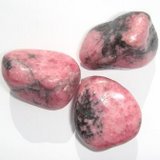
Rhodonite jewelry
Rhodonite is a manganese inosilicate mineral (MnSiO₃) prized for its rose-pink to red body color, often crossed by black dendritic veins of manganese oxide. It belongs to the pyroxenoid group and is almost always opaque, though rare transparent crystals exist. Collectors and jewelers recognize Rhodonite by the contrast between its pink matrix and the inky black manganese patterns that make every cabochon read differently.
Rhodonite Origin and Key Properties
The most historically significant deposit is at Malyi Sedelnikovo in the Ural Mountains of Russia, where large masses were quarried from the 1790s to decorate the Russian imperial court — the sarcophagus of Empress Maria Alexandrovna was carved from a single 47-ton Ural block. Other producing regions include Broken Hill in New South Wales, Australia (which yields a zinc-rich variety called fowlerite), Franklin in New Jersey, Minas Gerais in Brazil, Madagascar, Sweden, and British Columbia, Canada, where Rhodonite is the provincial mineral.
Rhodonite measures 5.5 to 6.5 on the Mohs scale, with a specific gravity around 3.4 to 3.7 and a vitreous to pearly luster. The chemical formula is MnSiO₃, though manganese is often partly replaced by iron, calcium, magnesium, or zinc — calcium-rich material grading toward bustamite, zinc-rich material classified as fowlerite. Most cutting-grade Rhodonite is opaque pink with black veining; cleaner, semi-translucent red material from Brazil and Madagascar is faceted but uncommon.
Treatments are rare. Commercial Rhodonite is typically untreated — the stone is cut, polished, and sold as-is. Some lower-grade material may be stabilized with a clear resin to fill surface pits before polishing, and dyed imitations (often dolomite or howlite) surface occasionally, so provenance matters. Assume untreated unless a seller states otherwise.
Rhodonite in Sterling Silver Jewelry
Because Rhodonite is usually opaque, cabochons and beads dominate the market, with faceted stones reserved for rare translucent rough. Freeform polished slabs show off the black veining and work well in pendants, while calibrated round and oval cabs suit rings and stud earrings. Sterling silver (.925) is the standard setting metal: the cool gray of silver sharpens the pink without competing with it, and the black manganese veins pick up the metal's tone for a cohesive look. Expect rhodonite jewelry at SilverRush Style to run roughly $25 for bead bracelets and small pendants up to about $120 for statement rings and multi-stone necklaces.
Designers often pair Rhodonite with marcasite or oxidized silver to echo the black veining, or set it in plain bezels to let the stone carry the piece. Bead strands — 6mm, 8mm, and 10mm rounds are most common — remain a steady seller because the matrix pattern varies bead to bead.
Care and Cleaning
Clean Rhodonite with warm water, mild soap, and a soft cloth. Skip ultrasonic and steam cleaners — the perfect prismatic cleavage near right angles makes the stone prone to fracture along those planes. Avoid household chemicals, acids, and prolonged sunlight, which can fade the pink. Store pieces separately in a soft pouch to prevent harder gems from scratching the surface.
Frequently Asked Questions
Is Rhodonite the same as Rhodochrosite?
No. Rhodonite is a manganese silicate (MnSiO₃) with black veining and a hardness of 5.5-6.5. Rhodochrosite is a manganese carbonate (MnCO₃), softer at 3.5-4, and shows banded pink-and-white patterns rather than black veins.
Can Rhodonite be worn every day?
Yes for earrings, pendants, and brooches. For rings, choose a protective bezel setting and remove the piece during manual work — the cleavage makes it vulnerable to sharp impacts despite its moderate hardness.
What causes the black veins in Rhodonite?
The black lines are manganese oxide — usually pyrolusite or manganite — that formed along fractures and grain boundaries in the pink silicate matrix. Stones without veining exist but command higher prices.
Is natural Rhodonite expensive?
Commercial cabochon-grade Rhodonite is affordable, generally $2-$10 per carat set in silver. Clean translucent red material from Brazil or faceted gem-quality stones from the Urals are rare and can exceed $100 per carat.
Talk to Our Jewelry Experts
Monday to Friday from 9AM to 5PM EST
