


 NECKLACES

 Shop now, pay later
Petrified wood
Petrified wood jewelry
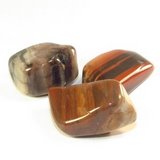
Petrified wood is a fossilized material formed when ancient tree tissue is replaced by silica-rich minerals over millions of years, producing a stone that preserves the original grain and cellular structure of the wood. Classified as a mineraloid built primarily from chalcedony and quartz (SiO₂), it ranges in color from brown and tan to red, gold, cream, gray, and black depending on trace minerals present during fossilization. The specimens used in our jewelry show warm brown tones with reddish banding, opaque clarity, and a polished finish typical of cabochon-grade material.
Origin and Key Properties of Petrified Wood
Major deposits occur in Arizona (Petrified Forest National Park, where collection is prohibited but surrounding private lands supply lapidary material), Washington State, Oregon, Nevada, and Utah. International sources include Argentina's Patagonia region, Madagascar, Indonesia (Java and Sumatra produce highly silicified material), and Egypt. Most jewelry-grade rough on the US market comes from the American Southwest and Indonesia.
The stone registers 6.5 to 7 on the Mohs scale, matching its parent quartz chemistry. Its hardness makes it suitable for rings, though the material can be brittle along internal fractures left by the original wood grain. Colors come from trace elements: iron oxides produce red and yellow, manganese creates pink and black, copper yields green and blue, and carbon produces black. Transparency is opaque. The chemical formula is essentially SiO₂ with minor impurities, and the specific gravity runs 2.6 to 2.7.
Treatments: most petrified wood sold for jewelry is untreated beyond cutting and polishing. Some lower-grade material is stabilized with resin or epoxy to fill voids and prevent chipping during setting. Dye is rarely used because natural mineral coloring already produces strong tones. We disclose stabilization when it applies to a specific piece.
Petrified Wood in Sterling Silver Jewelry
Cabochon is the standard cut for petrified wood because it displays the banded grain patterns that collectors buy the stone for. Freeform slabs, round cabs, and oval cabs are most common, and rough or slice-cut pendants appear for pieces that emphasize the wood-ring pattern. Faceting is uncommon since the material is opaque. Sterling silver (.925) suits the stone's earthy palette: the cool white metal frames the brown, red, and gold tones without competing with them, and silver bezels protect the edges where the stone is most likely to chip.
Our petrified wood jewelry generally runs $40 to $180, with rings and pendants on the lower end and larger statement cuffs or multi-stone pieces at the higher end. Each listing shows the actual stone you receive, since no two slices of petrified wood carry the same grain.
Care and Cleaning
Clean with warm water, mild soap, and a soft cloth. Avoid ultrasonic cleaners and steam, which can work into natural fractures and loosen stabilizing resin where present. Keep the stone away from bleach, chlorine, and abrasive polishes. Store separately in a soft pouch to prevent scratching from harder gems, and remove jewelry before heavy manual work to protect the stone from sharp impacts.
Frequently Asked Questions
What does petrified wood look like?
Polished petrified wood looks like a cross-section or slab of tree wood rendered in stone, with visible growth rings, grain lines, and sometimes bark patterns. Colors range from warm browns and reds to gold, cream, gray, and black, often banded or mottled. The surface takes a high polish and feels cool and hard like quartz.
Is petrified wood a real gemstone?
Yes. It is a fossilized organic material replaced by silica minerals, primarily chalcedony and quartz, which places it in the broader quartz family for gemological purposes. It is cut, polished, and set in jewelry the same way other quartz-family stones are.
How old is petrified wood?
Most commercially available petrified wood is between 100 and 250 million years old, dating to the Triassic and Jurassic periods. Arizona's specimens from the Chinle Formation average around 225 million years old. Some deposits in Argentina and other regions are older or younger depending on local geology.
Can petrified wood be worn in a ring?
Yes, with reasonable care. At 6.5 to 7 on the Mohs scale it handles daily wear, but a bezel setting is preferable to prongs because the material can chip along old wood-grain fractures. Remove the ring for gardening, lifting, and cleaning with harsh chemicals.
Talk to Our Jewelry Experts
Monday to Friday from 9AM to 5PM EST
