


 NECKLACES

 Shop now, pay later All Bracelets & Necklaces 96% OFF + All Rings 96% OFF
 Obsidian
Obsidian jewelry
Obsidian is a naturally occurring volcanic glass formed when felsic lava extrudes from a volcano and cools so rapidly that atoms cannot arrange into a crystalline structure. Classified as a mineraloid rather than a true mineral, it shows a conchoidal fracture, a glassy luster, and colors ranging from jet black and smoky brown to mahogany, gold sheen, rainbow sheen, and the white-spotted variety known as snowflake obsidian. Its chemistry is roughly 70–75% silicon dioxide (SiO₂), with smaller amounts of magnesium oxide, iron oxide, and trace elements that drive color variation.
Origin and Key Properties of Obsidian
Significant obsidian deposits occur wherever rhyolitic volcanism has occurred: the western United States (Glass Buttes in Oregon, Obsidian Cliff in Yellowstone, Coso Volcanic Field in California, Apache Tears localities in Arizona and New Mexico), central Mexico (Hidalgo and Jalisco), the Lipari Islands off Italy, Armenia's Gutansar volcano, Iceland, and the Caucasus. The stone was a strategic resource in antiquity — Mesoamerican cultures knapped it into blades and mirrors, and Pliny the Elder described "Obsianus lapis" in his Natural History, naming it after a Roman called Obsius who reportedly brought samples from Ethiopia.
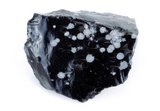
Obsidian registers 5–5.5 on the Mohs scale, with a specific gravity around 2.35–2.60 and a refractive index near 1.48–1.51. It is translucent at thin edges but typically opaque in jewelry-size pieces. Snowflake obsidian, the variety shown on this page, develops its white rosettes from cristobalite — radial clusters of a high-temperature silica polymorph that crystallize within the glass matrix over time. Rainbow and sheen varieties owe their optical effects to aligned nanoscale inclusions of magnetite or hedenbergite.
Obsidian is one of the few gem materials that is rarely treated. It is not dyed, heated, irradiated, or fracture-filled in normal commercial production — the natural glass already has strong color and sheen, and treatments would not improve it. The main caveat is synthetic or glass imitations: man-made slag glass is sometimes sold as obsidian, so provenance matters. Every piece sold here is natural.
Obsidian in Sterling Silver Jewelry
Because obsidian is a glass, it cuts cleanly into cabochons, spheres, faceted ovals, and carved cameos or skulls. Cabochon is the most common cut for rings and pendants, as it showcases sheen and snowflake patterning without the light leakage that faceting can produce. The deep black body reads crisply against the cool white of sterling silver (.925), and the metal's reflectivity picks up sheen play from rainbow and gold-sheen varieties. Our obsidian jewelry typically runs from about $25 for stud earrings and simple beaded pieces up to $120 for larger statement rings and pendants, with most items in the $35–$75 range.
Snowflake obsidian is particularly suited to silver bezel settings, where a polished rim frames the contrast between black glass and white cristobalite rosettes. Faceted obsidian beads are common in men's bracelets, and raw, rough-edged slices work well as drop pendants for a more sculptural look.
Care and Cleaning
Clean obsidian with warm water, mild soap, and a soft cloth. Avoid ultrasonic and steam cleaners — the stone's conchoidal fracture and internal stresses make it prone to chipping under vibration. Keep it away from hard knocks, abrasive surfaces, and harsh chemicals including chlorine and acetone. Store pieces separately in a soft pouch so harder gems do not scratch the polished surface.
Frequently Asked Questions
Is obsidian a real gemstone or just glass?
Both. Obsidian is natural volcanic glass and is classified as a mineraloid because it lacks a crystalline structure. It has been used as a gem and tool material for thousands of years and is sold today as a genuine semi-precious stone.
What colors does obsidian come in?
The base color is usually black, but trace elements and inclusions produce mahogany (iron), gold sheen and silver sheen (aligned gas bubbles), rainbow sheen (magnetite nanocrystals), and snowflake obsidian with white cristobalite rosettes.
How hard is obsidian compared to other gemstones?
Obsidian sits at 5–5.5 on the Mohs scale, softer than quartz (7) or topaz (8). It can scratch and chip, so it works better in earrings and pendants than in rings worn daily.
Where does most jewelry-grade obsidian come from?
Mexico and the western United States supply the bulk of commercial obsidian, with additional material from Armenia, Italy's Lipari Islands, and Iceland. Snowflake obsidian on the US market is most often sourced from Utah, Arizona, and northern Mexico.
Talk to Our Jewelry Experts
Monday to Friday from 9AM to 5PM EST
