


 NECKLACES

 Shop now, pay later
Larimar
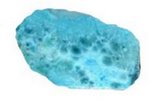
Larimar jewelry
Larimar is a rare blue variety of pectolite, a sodium calcium silicate with the chemical formula NaCa₂Si₃O₈(OH). Its color runs from soft white and pale sky blue to deep volcanic blue and blue-green, often streaked with white patterns that resemble sunlight filtering through shallow Caribbean water. The stone is opaque, forms in botryoidal (grape-like) masses, and owes its blue hue to copper substituting for calcium in the crystal structure. It is sometimes mistaken for turquoise or blue jade, but its chemistry and geology are distinct.
Origin and Key Properties of Larimar
Larimar comes from a single source on Earth: a small mountainous zone in the Barahona Province of the Dominican Republic, near the village of Los Chupaderos. The stone forms when hot volcanic gases force mineral-rich fluids into gas cavities in basaltic lava, where pectolite crystallizes and picks up its blue tone from copper ions. The first recorded request to mine the area came in 1916 from Father Miguel Domingo Fuertes Loren, but the Ministry of Mining denied the permit. The modern rediscovery dates to 1974, when Miguel Méndez and Peace Corps volunteer Norman Rilling found blue pebbles along the Bahoruco coast. Méndez named the stone by combining "Larissa," his daughter's name, with "mar," the Spanish word for sea.
On the Mohs scale, Larimar measures 4.5 to 5, softer than quartz and most agates. It is always opaque, with a specific gravity around 2.7 to 2.9. Top-grade material shows an even, saturated volcanic blue with minimal red or black iron oxide inclusions; lower grades run paler, greener, or more heavily mottled. Because the deposit is geographically limited and mined by hand through narrow vertical shafts, supply stays constrained and prices for AAA-grade rough keep climbing.
Larimar is rarely treated. Unlike turquoise, it is not routinely stabilized, dyed, or resin-impregnated, because the stone takes a good polish on its own and heating damages the blue color. Prolonged sun exposure and heat above roughly 200°C can fade the blue toward white or gray, so reputable cutters and sellers avoid anything that adds heat. If a seller cannot confirm untreated status, assume the material is natural but ask directly.
Larimar in Sterling Silver Jewelry
Because Larimar is soft and opaque, it is almost always cut as a cabochon — oval, round, pear, or freeform domes that show off the water-pattern chatoyancy. Faceting is uncommon and usually reserved for very small accent stones. Rough-cut or slab pieces appear in statement pendants and cuffs, where the natural botryoidal surface is left partly visible. The cool white glow of sterling silver (.925) suits the stone better than yellow gold for most buyers, since the metal echoes the white veining and keeps the blue reading clean rather than green.
Our larimar jewelry at SilverRush Style typically runs from around $25 for small stud earrings and simple rings up to $150-$250 for large cabochon pendants and cuff bracelets set in heavier sterling. Price within that range tracks stone size, color saturation, pattern clarity, and the weight of the silver setting.
Care and Cleaning
Clean Larimar with warm water, mild soap, and a soft cloth or brush. Skip ultrasonic and steam cleaners, household chemicals, and any jewelry dip, since these can attack the stone and the silver bezel. Keep pieces out of direct sunlight for long stretches and away from hot cars or windowsills, because UV and heat can dull the blue. Store in a soft pouch, separate from harder stones that could scratch the surface.
Frequently Asked Questions
Is Larimar a rare stone?
Yes. Larimar is mined in only one location worldwide, a roughly one-square-kilometer area in Barahona Province, Dominican Republic. Extraction is done by hand through narrow shafts, so output is limited and fine-grade blue material is genuinely scarce.
Can Larimar get wet?
Brief contact with water is fine, and cleaning with warm soapy water is recommended. Avoid prolonged soaking, hot water, chlorinated pools, and saltwater, since repeated exposure can weaken adhesives in bezel settings and dull the polish.
Does Larimar fade in sunlight?
It can. Extended UV exposure and high heat shift the blue toward gray or white over time. Everyday wear is not a problem, but do not store Larimar on a sunny shelf or leave it in a hot car.
How can I tell if Larimar is real?
Natural Larimar shows irregular white veining and soft color zoning, with occasional red or black iron oxide flecks. Dyed howlite or resin imitations look too uniform, often with a painted blue surface over a white base visible at the drill hole. A Mohs hardness near 5 and a cool feel in the hand also help confirm the real stone.
Talk to Our Jewelry Experts
Monday to Friday from 9AM to 5PM EST
