


 NECKLACES

 Shop now, pay later
Lapis Lazuli
Lapis Lazuli jewelry
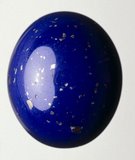
Lapis Lazuli is a deep blue metamorphic rock prized as a semi-precious gemstone for more than 6,000 years. Its color comes from lazurite, a sodium aluminum silicate containing sulfur, while the golden flecks common in better specimens are pyrite inclusions and the white veining is calcite. The stone is opaque, ranges from violet-blue to greenish-blue, and is almost always cut as cabochons, beads, or carvings rather than faceted.
Origin and Key Properties of Lapis Lazuli
The most historically significant deposit sits in the Sar-e-Sang mines of Badakhshan in northeastern Afghanistan, worked continuously for at least 6,500 years and still the source of the finest material on the market. Commercial-grade lapis also comes from the Andes region of Chile (typically paler and more heavily veined with calcite), the Lake Baikal area of Russia, and smaller deposits in Pakistan, Myanmar, and the United States (Colorado and California). Afghan rough remains the benchmark for the saturated "ultramarine" blue that Renaissance painters ground into pigment.
Lapis lazuli rates 5 to 5.5 on the Mohs scale, making it softer than quartz and vulnerable to scratching. It is a rock rather than a single mineral, with lazurite typically comprising 25–40% of the mass alongside calcite, pyrite, sodalite, hauyne, and diopside. The chemistry of the lazurite component is (Na,Ca)₈(AlSiO₄)₆(S,SO₄,Cl)₂. Specific gravity runs 2.7–2.9, and the stone is opaque with a dull to vitreous luster when polished.
Treatments are common and buyers should know what they are getting. Lower grades are routinely dyed with Prussian blue or similar colorants to mask gray calcite; the dye rubs off on a cotton swab dipped in acetone. Wax and resin impregnation is also used to improve polish and seal porous material. Reconstituted "lapis" made from powdered stone bonded with resin circulates in cheap jewelry. At SilverRush Style we sell natural, untreated or wax-stabilized lapis only and do not carry dyed or reconstituted material.
Lapis Lazuli in Sterling Silver Jewelry
Because lapis is opaque and valued for surface color, it is almost always cut en cabochon, carved, or strung as round or faceted beads. Faceted lapis exists but is uncommon and mainly used in men's signet rings or ornamental inlay. The cool tone of sterling silver (.925) reads as a neutral setting for the deep blue body color and picks up the golden pyrite flecks without competing with them the way yellow gold can. Oxidized silver bezels further deepen the contrast and suit the stone's ancient, amuletic character.
Our lapis lazuli jewelry collection spans rings, pendants, earrings, and bracelets. Typical pricing at SilverRush Style runs $25–$60 for earrings and small pendants, $40–$120 for rings and statement pendants, and $80–$200 for bead necklaces and larger cuffs, depending on stone size, grade, and silverwork.
Care and Cleaning
Clean lapis with a soft cloth and lukewarm water with mild soap, then dry immediately. Avoid ultrasonic cleaners, steam, household chemicals, perfume, hairspray, and prolonged sun exposure, all of which can damage the polish, leach wax stabilizers, or fade dyed material. Store pieces separately in a soft pouch so harder stones do not scratch the surface, and remove lapis jewelry before swimming, showering, or working out.
Frequently Asked Questions
What does "lapis lazuli" mean?
The name combines the Latin lapis (stone) with the Medieval Latin lazulum, which traces through Arabic lāzaward to the Persian lāzhward, the name of a mining region. It translates as "stone of Lāzhward." The English words azure, azul, and azzurro share the same root.
Is lapis lazuli a crystal or a rock?
It is a rock, not a single mineral crystal. Lapis is an aggregate composed mainly of lazurite with calcite, pyrite, and several accessory minerals, which is why specimens show the familiar mix of blue, white, and gold.
How can I tell if lapis lazuli is real?
Real lapis feels cool and heavier than plastic imitations, shows natural variation in color, and usually contains pyrite flecks with a metallic luster (not painted-on gold). Rub the stone with an acetone-dampened cotton swab; if blue comes off, the piece is dyed. Howlite dyed blue and synthetic "Gilson lapis" are the most common substitutes.
Can lapis lazuli get wet?
Brief contact with water during hand washing will not harm the stone, but prolonged soaking can dull the polish and degrade any wax stabilizer. Remove lapis jewelry before showering, swimming in chlorinated pools, or using saltwater, and dry the stone promptly after cleaning.
Talk to Our Jewelry Experts
Monday to Friday from 9AM to 5PM EST
