


 NECKLACES

 Shop now, pay later
Labradorite
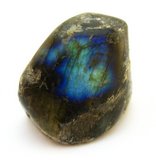
Labradorite jewelry
Labradorite is a feldspar mineral from the plagioclase series, prized for labradorescence — a schiller effect that flashes blue, green, gold, or violet when the stone is tilted under light. Chemically a calcium-sodium aluminum silicate with the formula (Ca,Na)(Al,Si)4O8, it typically shows a gray to dark gray or smoky body color with the characteristic iridescent flash across cleavage planes. The specimen shown here displays dominant blue and green flash on a rough, opaque surface — the raw form most gem cutters start with before shaping cabochons.
Labradorite Origin and Key Properties
Labradorite takes its name from the Labrador Peninsula in Canada, where Moravian missionaries documented it on the island of Paul in 1770. Commercial deposits now come from several regions: Finland produces spectrolite, a variety with full-spectrum flash mined near Ylämaa since 1940; Madagascar supplies most of today's cabochon-grade rough; and Russia, Ukraine, Mexico, and the Oregon sunstone fields also yield gem material. Large architectural blocks still come from Labrador and Quebec.
On the Mohs scale, labradorite rates 6 to 6.5, with perfect cleavage in two directions — softer than quartz and requiring more careful wear than agate or topaz. It is typically translucent to opaque, though rare Oregon and Madagascar material can be transparent and faceted. Specific gravity runs 2.68 to 2.72. The labradorescence itself is caused by light interference along microscopic lamellar intergrowths within the crystal, not by inclusions, though magnetite, ilmenite, and rutile needles are sometimes present.
Treatment disclosure: most labradorite on the market is untreated. The flash is a natural structural effect and cannot be induced. Some low-grade material is backed with black epoxy or assembled into doublets to deepen the flash — reputable sellers will state this. Surface waxing or oiling to improve polish is occasionally done on porous pieces. The stones SilverRush Style sets are natural, untreated cabochons.
Labradorite in Sterling Silver Jewelry
The overwhelming majority of labradorite is cut en cabochon because a domed, polished surface is what activates the labradorescence across the widest viewing angle. Oval, round, freeform, and pear cabochons are standard; faceted labradorite exists but is niche, made from transparent Oregon or Madagascar rough. Rose cuts and raw, uncut slices also appear in artisan work.
Sterling silver (.925) is the natural setting metal for this stone. The cool gray of silver echoes the stone's body color without competing with the blue and green flash, and oxidized silver bezels push the iridescence forward. Our labradorite jewelry collection spans rings, pendants, earrings, and bracelets, with most pieces priced between $30 and $180 depending on stone size and setting complexity. Larger statement pendants and cocktail rings with premium spectrolite flash run higher.
Care and Cleaning
Clean labradorite with warm water, mild soap, and a soft cloth. Avoid ultrasonic and steam cleaners — the perfect cleavage makes the stone prone to fracture from vibration. Keep it away from household chemicals, chlorinated pools, and prolonged direct heat. Store each piece separately in a soft pouch so harder stones don't scratch the polished surface, and remove rings before physical work.
Frequently Asked Questions
What does labradorite look like?
Labradorite has a gray, smoky, or dark body color with an internal flash of blue, green, gold, or occasionally violet and red that shifts as you tilt the stone. When held flat against the light at the wrong angle it can look dull; at the right angle the labradorescence lights up across the surface.
Is labradorite a real gemstone?
Yes. Labradorite is a natural feldspar mineral first identified in 1770 and recognized as a gemstone variety of plagioclase. It is used in fine and artisan jewelry worldwide and comes in named varieties including spectrolite from Finland and Oregon sunstone-adjacent material.
How hard is labradorite, and can I wear it daily?
Labradorite is 6 to 6.5 on the Mohs scale with perfect cleavage. That makes it fine for pendants, earrings, and occasional-wear rings, but it's not the best choice for a daily-wear ring that takes knocks against hard surfaces. A protective bezel setting in sterling silver extends its life considerably.
What is the difference between labradorite and spectrolite?
Spectrolite is a trade name for a variety of labradorite mined in Ylämaa, Finland, that shows the full visible spectrum of flash colors on a darker, often near-black body. Standard labradorite usually flashes blue and green only. Spectrolite commands higher prices per carat due to color range and scarcity.
Talk to Our Jewelry Experts
Monday to Friday from 9AM to 5PM EST
