


 NECKLACES

 Shop now, pay later
Jade (jadeite)
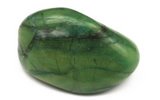
Jade (jadeite) is a sodium-aluminum silicate pyroxene mineral with the chemical formula NaAlSi₂O₆, prized for its dense microcrystalline structure and translucent green tones. The specimen shown here is a polished cabochon showing the opaque-to-semi-translucent body, saturated green color, and dark mineral inclusions typical of natural jadeite. It is one of two distinct minerals called jade, the other being nephrite (a calcium-magnesium amphibole), and the two were only separated by French mineralogist Alexis Damour in 1863. Jadeite is the rarer and harder of the pair, and the form most often graded as "Imperial Jade" when it reaches top translucency and emerald-green color.
Jade (jadeite) Origin and Key Properties
The world's primary source of gem-grade jadeite is the Kachin State of northern Myanmar (Burma), where the Hpakant mining district has supplied Chinese carvers since the late 1700s. Commercial deposits are also worked in Guatemala's Motagua River valley — the source of the blue-green "Olmec" jadeite used in Mesoamerica from roughly 1500 BC — along with smaller occurrences in Russia (the Polar Urals), Japan (Itoigawa), Kazakhstan, and California's San Benito County. Jadeite forms in subduction-zone metamorphic rocks under high pressure and relatively low temperature, usually in association with serpentinite and albite.
Jadeite rates 6.5 to 7 on the Mohs scale with a specific gravity of 3.30 to 3.38, making it noticeably denser than nephrite (SG 2.95). Transparency runs from opaque to semi-translucent, with rare "glass jade" approaching transparency. Color comes from trace chromium (bright green), iron (yellow, brown, darker greens), and manganese (lavender); white, black, orange, red, and blue-green material is also mined. The fracture is splintery and the aggregate structure gives jadeite its famous toughness — it resists breakage better than most gems of comparable hardness.
Treatments are widespread and must be declared. The trade uses three grades: Type A is natural jadeite with only surface wax; Type B has been bleached with acid and impregnated with polymer to improve clarity and color; Type C is dyed. Type B and B+C stones degrade over years and are worth a fraction of Type A. At SilverRush Style we sell Type A natural jadeite only.
Jade (jadeite) in Sterling Silver Jewelry
Because jadeite's beauty lives in its color and translucency rather than light return from facets, the stone is almost always cut en cabochon, as carved plaques, or as polished bangles and beads. Faceting is reserved for rare transparent material. The cool white sheen of .925 sterling silver sits well against green and lavender jadeite without competing for attention, and silver bezels protect the softer edges of a cabochon from chipping. Most jadeite pieces in our jade (jadeite) jewelry collection fall between $30 and $180, with larger carved pendants and bangles reaching higher depending on color grade and translucency.
Care and Cleaning
Clean jadeite with warm water, mild soap, and a soft cloth. Skip ultrasonic and steam cleaners — they can open fractures and strip surface wax — and keep the stone away from bleach, acetone, and perfume. Store jadeite pieces separately in a soft pouch so harder gems like topaz or sapphire do not scratch the polish, and rinse after wearing in chlorinated pools.
Frequently Asked Questions
Is jadeite the same as jade?
"Jade" is an umbrella term covering two different minerals: jadeite (a pyroxene) and nephrite (an amphibole). Both have been carved for millennia, but jadeite is harder (6.5–7 vs 6–6.5), denser, and reaches the saturated green and lavender colors collectors associate with Imperial Jade.
How can I tell if jadeite is natural?
Ask for the treatment grade. Type A is untreated (only waxed); Type B is acid-bleached and polymer-filled; Type C is dyed. Gem labs like GIA and GIT issue certificates identifying the type. Under magnification, Type B often shows a spiderweb of etched channels, and dyed stones show color concentrating in fractures.
Where does most jadeite come from?
Roughly 70% of commercial jadeite is mined in Myanmar's Hpakant region. Guatemala supplies most of the blue-green and black material on the market, and smaller volumes come from Russia, Japan, and Kazakhstan.
Can jadeite be worn daily?
Yes. With Mohs 6.5–7 hardness and exceptional toughness from its interlocking crystal structure, jadeite handles daily wear in rings, pendants, and bangles. Keep it away from hard knocks on stone or metal, since a sharp impact on the edge of a cabochon can still chip it.
Talk to Our Jewelry Experts
Monday to Friday from 9AM to 5PM EST
