


 NECKLACES

 Shop now, pay later
Hematite
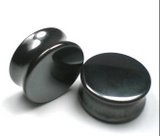
Hematite jewelry
Hematite is an iron oxide mineral (Fe₂O₃) and the principal ore of iron, recognized in jewelry for its metallic silver-gray to black luster and dense weight in the hand. The name comes from the Greek haima (blood), a reference to the deep red streak the stone leaves when rubbed on unglazed porcelain, and to the rust-red powder form once used as pigment. In cut and polished form, Hematite reads as opaque, mirror-bright, and cool to the touch, with colors ranging from gunmetal and steel-gray to brown-red and near-black.
Origin and Key Properties of Hematite
Major commercial deposits sit in the banded iron formations of Minas Gerais, Brazil; the Lake Superior region of the United States and Canada; the Kursk Magnetic Anomaly in Russia; and the Hamersley Basin of Western Australia. Historically significant material also came from Cumbria, England (the classic "kidney ore" botryoidal form) and from Elba, Italy, where the Romans mined it for both iron and pigment. Gem-grade specular hematite used for cabochons is sourced primarily from Brazil and Morocco.
Hematite rates 5.5–6.5 on the Mohs scale, harder than pure iron but notably brittle, with a specific gravity near 5.3 that gives finished pieces their characteristic heft. The mineral is opaque in all varieties, which include specularite (platy, sparkly), kidney ore (botryoidal red-brown), iron rose (rosette clusters), and martite (pseudomorphs after magnetite). The streak is always rust-red, a reliable identifier.
A word on treatments: most "rainbow hematite" and nearly all "magnetic hematite" sold in bead form are synthetic. The magnetic material — often labeled "hematine" or "hemalyke" — is a reconstituted barium-strontium ferrite. Natural hematite is weakly magnetic at best. At SilverRush Style we stock natural specular hematite cabochons; if a piece is synthetic or reconstituted, the listing says so.
Hematite in Sterling Silver Jewelry
Hematite is most often cut as cabochons, flat tablets, and faceted rose cuts that take advantage of its mirror polish. Smaller pieces turn up as drilled beads, briolettes, and carved intaglios. Because the stone is opaque and reflective, cutters avoid thin facets that would chip; domed cabs and smooth geometric forms hold up best. You will also see raw specular clusters in statement rings, though these require protective bezel settings.
Sterling silver (.925) is the logical partner. The cool white of silver mirrors the metallic sheen of the stone, and a polished bezel effectively extends the cabochon's reflective surface. Oxidized silver settings push the contrast the other way, framing the stone's brightness against matte black. Typical SilverRush Style pricing for hematite jewelry runs from about $25 for stud earrings and simple pendants to $120+ for larger rings and multi-stone bracelets. Browse the full selection at the category link.
Care and Cleaning
Clean hematite with a soft cloth and lukewarm water only. Skip ultrasonic and steam cleaners — the mineral is brittle and can fracture along cleavage planes. Avoid prolonged water exposure (iron content means it can develop rust spots over time), acidic cleaners, and chlorinated pools. Store each piece separately in a soft pouch; hematite is hard enough to scratch softer stones like opal and pearl.
Frequently Asked Questions
What is hematite?
Hematite is a natural iron oxide mineral with the formula Fe₂O₃, mined primarily as iron ore and cut as a gemstone for its metallic silver-gray to black polish. It rates 5.5–6.5 on the Mohs scale and leaves a red streak.
Is hematite magnetic?
Natural hematite is only weakly magnetic. The strongly magnetic "hematite" beads sold in many bracelets are synthetic reconstituted ferrite, usually labeled hematine or hemalyke.
Can hematite get wet?
Brief contact with water is fine, but prolonged soaking can cause the iron-rich stone to develop rust spots along surface fractures. Remove hematite jewelry before swimming, showering, or washing dishes.
Why does hematite feel heavy?
Hematite has a specific gravity of about 5.3, nearly twice that of quartz. The dense iron content is what gives a polished cabochon its noticeable weight relative to its size.
Talk to Our Jewelry Experts
Monday to Friday from 9AM to 5PM EST
