


 NECKLACES

 Shop now, pay later
Gaspeite (gaspetite)
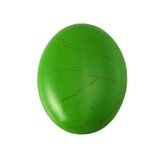
Gaspeite (gaspetite) is a rare nickel carbonate mineral prized for its opaque apple-green color, often marked by brown or black matrix veining. It belongs to the calcite group of carbonates, with a chemistry of (Ni,Mg,Fe)CO₃, and ranks among the few green gems whose color comes from nickel content rather than chromium or copper. Most specimens reach the market as polished cabochons, since the stone is too opaque and too soft for faceting.
Origin and Key Properties of Gaspeite (gaspetite)
The mineral was first described in 1966 by D.W. Kohls and J.L. Rodda from samples collected on the Gaspé Peninsula in Quebec, Canada, which gave the stone its name. Commercial-grade rough, however, comes almost entirely from Western Australia — specifically the Widgiemooltha and Kambalda nickel fields, where gaspeite forms in the weathered oxidation zones above nickel sulfide deposits such as pentlandite, millerite, and violarite. Smaller finds have been reported in New Mexico and in parts of Greece, but Australian material dominates the jewelry trade.
Gaspeite has a Mohs hardness of 4.5 to 5, a specific gravity of roughly 3.6 to 3.7, and a vitreous to dull luster. Transparency runs from translucent on thin edges to fully opaque. Color ranges from pale yellow-green to a saturated apple green; the richer, more even greens command higher prices, while stones with heavy brown limonite or host-rock matrix are valued for their pattern rather than pure color.
Treatments are worth stating plainly: most gaspeite sold today is natural and untreated. Because the stone is porous in places, some rough is stabilized with a clear resin to harden it for cutting, similar to the stabilization used on softer turquoise. Dyeing is uncommon but does occur on lower grades to deepen the green. We disclose any known treatment on the individual product page.
Gaspeite (gaspetite) in Sterling Silver Jewelry
Because gaspeite is opaque and moderately soft, it is almost always cut as a cabochon — oval, round, teardrop, or freeform shapes that follow the rough. Faceted gaspeite exists but is rare and usually reserved for collectors. Raw and tumbled pieces show up in rustic pendants and bead strands. The green reads cleanly against oxidized silver and against high-polish .925, and silver's neutral tone keeps the nickel-green color from shifting the way yellow gold can. Native American silversmiths in the American Southwest adopted gaspeite in the 1980s and 1990s as a substitute for green turquoise, and that tradition continues in much of the inlay and channel work sold today.
At SilverRush Style, prices for gaspeite (gaspetite) jewelry typically run from about $30 for small stud earrings and rings up to $150 or more for larger statement cuffs and pendants with clean apple-green cabochons. Multi-stone inlay pieces and bead necklaces fall in the middle of that range.
Care and Cleaning
Clean gaspeite with warm water, mild soap, and a soft cloth. Skip ultrasonic and steam cleaners — vibration and heat can damage stabilized stones and loosen bezel settings. Keep the stone away from household chemicals, perfume, and prolonged direct sunlight, since nickel-colored minerals can fade with long UV exposure. Store pieces in a lined pouch, separate from harder gems like quartz or topaz that will scratch the surface.
Frequently Asked Questions
Is gaspeite a rare stone?
Yes. Gaspeite is considered one of the rarer nickel carbonates. Gem-grade material comes almost exclusively from the nickel fields of Western Australia, and the main Widgiemooltha source has been worked heavily, which keeps supply limited.
How can you tell real gaspeite from imitations?
Real gaspeite has a specific gravity of 3.6–3.7, so it feels heavier than dyed howlite or magnesite of the same size. The green tends toward a slightly yellowish apple shade rather than the blue-green of chrysoprase, and natural pieces usually show brown iron-oxide veining or host-rock matrix.
Can gaspeite get wet?
Brief contact with water during hand-washing is fine. Avoid long soaks, hot tubs, chlorinated pools, and saltwater, since repeated exposure can affect stabilized material and tarnish the sterling silver setting.
What is gaspeite used for in jewelry?
Gaspeite is cut mainly into cabochons for rings, pendants, earrings, and Southwestern-style cuff bracelets. It also appears in bead strands and in multi-stone inlay work alongside turquoise, coral, and sugilite.
Talk to Our Jewelry Experts
Monday to Friday from 9AM to 5PM EST
