


 NECKLACES

 Shop now, pay later
Emerald
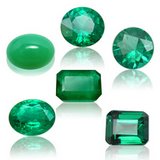
Emerald jewelry
Emerald is the green gem variety of the mineral beryl, a beryllium aluminum silicate colored by trace amounts of chromium and sometimes vanadium. Prized since antiquity, Emerald ranges from light grass green to a deep bluish green, with the most valued stones showing a pure, saturated hue often called "emerald green." Unlike most gems, inclusions in Emerald are expected and even romanticized as the "jardin" (French for garden), distinguishing natural stones from synthetic or imitation material.
Origin and Key Properties of Emerald
Colombia has been the benchmark source for over 500 years, with the Muzo, Chivor, and Coscuez mines producing stones known for their warm, slightly bluish-green color. Zambia's Kafubu deposits, discovered in the 1920s and commercially mined since the 1970s, yield stones with a cooler, bluish tone and fewer inclusions. Brazil (Bahia, Minas Gerais), Afghanistan (Panjshir Valley), Russia (Ural Mountains, mined since 1831), Ethiopia, and Pakistan round out the commercial supply. Historically, Egyptian mines near the Red Sea supplied stones to Cleopatra's court as early as 1500 BCE.
Emerald has the chemical formula Be₃Al₂(SiO₃)₆ and crystallizes in the hexagonal system. It rates 7.5 to 8 on the Mohs scale — hard enough for most jewelry use, but the stone's brittleness and internal fractures make it more fragile than its hardness suggests. Transparency runs from transparent in high-grade material to translucent or opaque in commercial grades. Specific gravity sits around 2.67 to 2.78, and the refractive index is 1.57 to 1.58.
Treatment is near-universal. An estimated 90% or more of commercial Emeralds are filled with cedar oil, paraffin, or polymer resins (such as Opticon) to reduce the visibility of surface-reaching fractures. Treatments are graded from none to minor, moderate, and significant. This is standard industry practice and should be disclosed at point of sale. Untreated Emeralds with strong color command significant premiums.
Emerald in Sterling Silver Jewelry
Faceted Emerald cuts — particularly the step-cut rectangular shape known as the "emerald cut" — maximize color while minimizing pressure on fracture-prone corners. Cabochons are common for opaque to translucent material and for vintage-style pieces, and raw or rough crystal slices appear in artisan designs. Sterling silver (.925) pairs well with Emerald because the cool white metal pushes the green forward without the yellow cast that gold can introduce, and bezel settings in silver help protect the stone's vulnerable edges. Browse our selection of emerald jewelry for rings, pendants, and earrings across this range. Prices at SilverRush Style typically run from around $30 for small cabochon pieces and commercial-grade faceted stones up to $200+ for larger, cleaner specimens set in substantial silver.
When selecting an Emerald, expect visible inclusions in almost every natural stone. Clarity grading for Emerald is done eye-clean rather than loupe-clean, and heavy inclusions reduce durability as well as value.
Care and Cleaning
Clean Emerald jewelry with lukewarm water, a drop of mild soap, and a soft brush. Avoid ultrasonic cleaners, steam cleaners, acetone, and harsh solvents — these strip the oil or resin filling and can turn a clear stone cloudy. Remove Emerald rings before gardening, dishwashing, or gym workouts. Store separately in a soft pouch away from harder gems like sapphire or diamond, and keep out of prolonged direct sunlight and dry heat, which can cause oils to evaporate.
Frequently Asked Questions
Are all Emeralds treated?
The vast majority of Emeralds on the market — roughly 90% or more — are oil- or resin-filled to improve clarity. Untreated stones exist but are rare and priced accordingly. Reputable sellers disclose treatment level.
How hard is Emerald compared to other gems?
Emerald rates 7.5 to 8 on the Mohs scale, softer than sapphire (9) and ruby (9) but harder than quartz (7). Its weakness isn't hardness but brittleness from internal fractures, which makes it more prone to chipping than its Mohs number suggests.
What's the difference between Emerald and green beryl?
Both are beryl, but only stones colored by chromium (and sometimes vanadium) with sufficient saturation qualify as Emerald. Pale or yellow-green beryl colored by iron is sold as green beryl and priced significantly lower.
Can I wear an Emerald ring every day?
Emerald works for regular wear in a protective bezel or halo setting, but it's not the best choice for rough daily wear. Remove it before manual work, avoid knocking it against hard surfaces, and re-oil the stone every few years if it starts looking dull.
Talk to Our Jewelry Experts
Monday to Friday from 9AM to 5PM EST
