


 NECKLACES

 Shop now, pay later
Druzy (titanium)
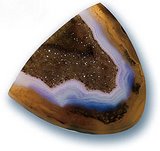
Druzy (titanium) is natural druzy quartz that has been coated with vaporized titanium and other metal oxides to produce an iridescent, metallic surface over a bed of tiny sparkling crystals. The base material is silicon dioxide (SiO₂) quartz, most often formed inside agate or chalcedony geodes, which is then treated in a vacuum chamber to fuse a microscopic layer of titanium onto the crystal tips. The result shifts through blue, violet, gold, green, and magenta depending on the viewing angle, while the underlying stone retains its natural banded brown, gray, or white body.
Origin and Key Properties of Druzy (titanium)
The raw druzy quartz used as a base comes from deposits in Brazil (Rio Grande do Sul), Uruguay, Mexico, Namibia, and India, where agate and amethyst geodes are mined and split to expose the crystalline interior. Specimens like the one shown here — a triangular section with brown and blue-white banding around a geode pocket — are typical of Brazilian and Uruguayan material. The titanium bonding process itself is done in labs, most commonly in the United States, Germany, and China.
Druzy quartz registers 7 on the Mohs scale, the same as standard quartz, with a chemical formula of SiO₂. The druzy surface is opaque to translucent, with a crystalline sparkle created by thousands of terminated quartz points measuring under 2 mm each. Body color depends on the host stone: white, gray, brown, smoky, or pale amethyst are standard. The titanium coating itself is permanent under normal wear but is a thin surface layer, not a natural color.
Treatment disclosure: every druzy (titanium) stone is enhanced. The metallic rainbow effect is produced by chemical vapor deposition, bonding titanium and other trace metals (often gold or niobium) to the crystal tips. The underlying quartz is natural and untreated; the color is not. This is the industry standard for this material and should always be disclosed at point of sale.
Druzy (titanium) in Sterling Silver Jewelry
Because the druzy surface is fragile and uneven, stones are almost never faceted. They are cut as freeform slices, triangles, ovals, or geode wedges and set as cabochons with the crystal face exposed. Bezel settings in sterling silver (.925) are the standard mounting — the metal wall protects the crystal edges while leaving the sparkling face open to light. The cool tone of sterling silver reads cleanly against the iridescent blues, purples, and greens of titanium-coated druzy without competing with them. Browse our full selection of druzy (titanium) jewelry for current rings, pendants, and earrings.
At SilverRush Style, druzy (titanium) pieces typically run from about $25 for small stud earrings to $90 for larger statement pendants and rings, depending on stone size and silverwork. Price is driven more by the surface area of the druzy face and the complexity of the silver setting than by the titanium treatment itself.
Care and Cleaning
Clean druzy (titanium) with a soft dry brush or a slightly damp microfiber cloth. Never use an ultrasonic cleaner, steam cleaner, or jewelry dip — the vibrations can loosen crystals and harsh chemicals will strip the titanium coating. Avoid chlorinated water, perfume, hairspray, and prolonged direct sunlight. Store each piece separately in a soft pouch to keep the crystal surface from being scratched or chipped by harder stones.
Frequently Asked Questions
Is druzy (titanium) a real stone?
Yes. The base is natural druzy quartz from agate or chalcedony geodes. The metallic rainbow color, however, is added by bonding titanium vapor to the crystal surface in a vacuum chamber. The stone is real; the color is a permanent surface treatment.
How hard is titanium druzy quartz?
The quartz base is 7 on the Mohs scale, which is durable enough for daily wear in rings and pendants. The weak point is not hardness but the raised crystal tips, which can chip against hard surfaces.
Can druzy (titanium) get wet?
Brief contact with plain water is fine. Remove the piece before showering, swimming, or cleaning, since chlorine, salt water, and soap residue can dull the titanium layer over time and collect between the crystal points.
Will the rainbow color fade?
The titanium bond is permanent under normal wear and will not fade from light exposure. It can, however, be scratched off or etched by abrasive cleaners, ultrasonic cleaning, and strong chemicals. Treat the surface as you would a delicate plated finish.
Talk to Our Jewelry Experts
Monday to Friday from 9AM to 5PM EST
