


 NECKLACES

 Shop now, pay later
Copper
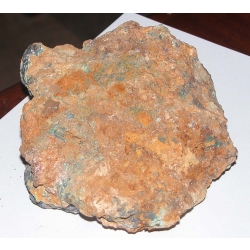
Copper jewelry
Copper is a native metallic element (chemical symbol Cu, atomic number 29) valued in jewelry for its warm reddish-orange hue and its long metallurgical record. As a mineral specimen, native Copper forms in masses, plates, wires, and dendritic sprays, often showing a green patina of malachite or a black-brown tarnish of copper oxides on exposed surfaces. It ranks among the few elemental metals with a natural color other than gray or silver, alongside gold and osmium.
Origin and Key Properties of Copper
Native Copper has been mined for at least 10,000 years. A copper pendant dated to roughly 8700 BC was recovered in what is now northern Iraq, and large-scale smelting developed in the Middle East and the Balkans by the fifth millennium BC. The richest historical deposit of native copper is the Keweenaw Peninsula of Michigan, where Indigenous peoples worked float copper from around 5000 BC. Today, the largest producers are Chile (Chuquicamata, Escondida), Peru, the Democratic Republic of the Congo, China, and the United States (Arizona, Utah, Michigan). Specimen-grade native Copper for lapidary use comes chiefly from Michigan, Arizona's Ray and Ajo mines, and Tsumeb in Namibia.
Copper measures 2.5 to 3 on the Mohs scale — softer than sterling silver — with a specific gravity of 8.9 and a face-centered cubic crystal structure. It is opaque with a metallic luster, ductile, and highly malleable. Fresh surfaces show a salmon-pink to peach color that oxidizes to the familiar rust-orange, then to brown, and eventually to green verdigris. In the rough specimen shown on this page, the rusty orange base with green patches is characteristic: the orange is oxidized native copper, the green is secondary malachite or brochantite formed by weathering.
Treatments are minimal but worth naming. Cut copper cabochons are usually sealed with a clear lacquer or wax to slow tarnish; some stabilized pieces are set in epoxy-bonded matrix (for example, copper-in-quartz or copper-in-basalt). Polished copper surfaces may be chemically patinated to emphasize green or blue tones. We disclose any coating or stabilization on the product page.
Copper in Sterling Silver Jewelry
Copper is most often cut as a freeform cabochon to preserve its native dendritic or massive texture, and sometimes sliced to show copper veining inside a host rock such as quartz or epidote. Faceting is rare because the metal is too soft to hold sharp edges; raw nugget settings are common in artisan work. Sterling silver (.925) is a sound pairing because the two metals share a warm luster without competing — silver cools the orange tones of copper and provides a harder bezel (Mohs ~2.5-3 for silver) that protects the softer stone. Our copper jewelry typically runs from about $25 for small pendants and earrings up to $120 for larger statement cuffs and pendants set with specimen-grade Michigan copper.
Care and Cleaning
Clean copper jewelry with a soft cloth and mild soapy water, then dry immediately. Avoid ultrasonic cleaners, steam, ammonia, and chlorinated water; these strip protective lacquer and accelerate tarnish. Keep pieces in an anti-tarnish pouch with a silica packet, away from leather (which releases sulfur) and from direct sunlight on patinated surfaces. A light rub with a silver polishing cloth restores shine to both the stone and the sterling setting.
Frequently Asked Questions
What does Copper look like as a stone?
Native Copper is opaque with a metallic luster. Fresh cuts are salmon-pink to peach; weathered surfaces turn rust-orange, brown, or green from oxidation and malachite growth. Specimens often show branching dendritic or wire-like forms.
How hard is Copper on the Mohs scale?
Copper rates 2.5 to 3 on Mohs. That is softer than quartz and about equal to gold, so copper jewelry needs protective bezels and careful storage to avoid scratches and dents.
Why does Copper turn green?
The green coating is verdigris — a mix of copper carbonates (malachite) and sulfates (brochantite) that forms when copper reacts with oxygen, moisture, and trace sulfur or chlorides in the air. It is a natural patina and does not harm the metal.
Is Copper jewelry safe to wear?
Yes, for most wearers. Some people notice a temporary green mark on the skin where copper contacts sweat; this washes off and is not toxic. A sterling silver setting reduces direct skin contact with the copper surface.
Talk to Our Jewelry Experts
Monday to Friday from 9AM to 5PM EST
