


 NECKLACES

 Shop now, pay later All Bracelets & Necklaces & Earrings 96% OFF + Other 95% OFF
 Citrine
Citrine jewelry
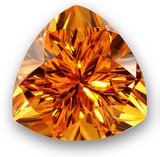
Citrine is the yellow-to-orange variety of crystalline quartz (silicon dioxide, SiO₂), colored by trace iron within its atomic structure. It ranges from pale lemon through golden honey to deep reddish-brown "Madeira" tones, all produced by the same Fe³⁺ impurities at different concentrations and oxidation states. The faceted orange specimen shown on this page is typical of the material used in fine jewelry: transparent, clean of visible inclusions, and cut to maximize light return. Natural, untreated citrine is one of the scarcer quartz varieties, which is why most stones on the market today begin life as amethyst or smoky quartz.
Citrine Origin and Key Properties
The main commercial source is Brazil, specifically the states of Rio Grande do Sul and Minas Gerais, where amethyst-bearing geodes are mined and then heat-treated to produce citrine. Naturally colored citrine occurs in smaller quantities in Madagascar, the Democratic Republic of the Congo, Spain (Salamanca), Russia (the Ural Mountains), Scotland, and parts of the United States including Colorado and North Carolina. Historically, the stone has been cut as a gem since ancient Greek and Roman times and saw a strong revival during the Art Deco period of the 1920s and 1930s.
As a member of the quartz family, citrine measures 7 on the Mohs scale, with a trigonal crystal system, vitreous luster, and a refractive index of 1.544–1.553. It is transparent to translucent, with specific gravity around 2.65. Color covers pale yellow, golden, amber, orange, and reddish-brown; saturated orange and Madeira grades command the highest prices.
Honest note on treatment: the large majority of citrine sold worldwide — likely above 90% — is heat-treated amethyst. Temperatures of 470–560°C convert purple amethyst into yellow or orange material, and the color is stable and permanent. Unheated natural citrine exists but is uncommon and usually pale. Irradiated quartz is also occasionally sold as citrine. We consider heat treatment standard and acceptable for this stone, and we disclose it.
Citrine in Sterling Silver Jewelry
Citrine takes a sharp polish and cuts well into faceted shapes — ovals, cushions, rounds, emerald cuts, and trillions — which bring out its fire and saturation. Cabochons and freeform rose cuts are used when the rough has softer color zoning or a more honeyed tone. Raw crystal points and druzy clusters also appear in pendants and statement rings. Sterling silver (.925) suits citrine for a practical reason: the cool white metal pushes warm yellow and orange hues forward without competing with them, the way yellow gold sometimes can. Our citrine jewelry typically runs $25–$180, depending on stone size, cut quality, and whether the piece is a simple solitaire or a multi-stone design.
Ring sizes of 6x8mm to 10x14mm are standard for everyday wear; larger 12x16mm and 14x20mm stones show up in cocktail rings and pendants where the color range has room to carry the design. Matching earrings, pendants, and bracelets are common because citrine rough is available in good sizes at reasonable cost.
Care and Cleaning
Clean citrine with warm water, mild dish soap, and a soft brush. Avoid steam cleaning and prolonged exposure to strong sunlight or high heat, both of which can fade the color over time. Ultrasonic cleaners are generally safe for untreated stones but we recommend skipping them since most citrine is heat-treated and may contain stress fractures. Store each piece separately in a soft pouch to prevent scratches against harder stones, and remove rings before gardening or heavy cleaning.
Frequently Asked Questions
What does citrine look like?
Citrine is a transparent quartz with color running from pale lemon yellow through golden amber to deep reddish-orange "Madeira." Faceted stones show strong brilliance and fire; cabochons display a softer, honey-like glow. The orange specimen pictured above is a representative faceted example.
Is citrine a real gemstone or just heated amethyst?
Both are real citrine. Citrine is defined by its yellow-to-orange color in quartz, regardless of origin. Naturally colored citrine is rare, so most stones on the market are amethyst heated to 470–560°C, which produces a stable, permanent color change.
How hard is citrine and is it suitable for daily wear?
Citrine rates 7 on the Mohs scale, the same as amethyst and all other quartz varieties. It holds up well in pendants, earrings, and bracelets. For rings worn daily, a protective bezel or halo setting helps guard against chips at the stone's edges.
Is citrine a birthstone?
Yes. Citrine is a traditional birthstone for November, alongside topaz. It is also associated with the 13th wedding anniversary.
Talk to Our Jewelry Experts
Monday to Friday from 9AM to 5PM EST
