


 NECKLACES

 Shop now, pay later
Chrysoprase
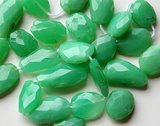
Chrysoprase jewelry
Chrysoprase is a nickel-bearing variety of chalcedony, a cryptocrystalline form of silica (SiO₂) prized for its apple-green to deep-green color. The name comes from the Greek chrysos (gold) and prason (leek), referencing the golden-green tint of finer specimens. Unlike most green gems that owe their color to chromium or iron, Chrysoprase gets its hue from trace nickel silicates within the quartz matrix, which makes it the most valuable member of the chalcedony family.
Origin and Key Properties of Chrysoprase
The most important commercial deposits sit in Marlborough, Queensland, Australia, where mining since the 1960s has produced material so saturated it is sometimes sold as "Australian jade." Historic European deposits at Szklary in Lower Silesia, Poland supplied stones for Frederick the Great and the Wenceslas Chapel in Prague during the 14th century. Additional sources include Goiás (Brazil), Tanzania, Madagascar, California, and Haneti in central Tanzania, where the related lemon chrysoprase is mined.
Chrysoprase rates 6.5 to 7 on the Mohs scale with a specific gravity of about 2.58 to 2.64. It is translucent to semi-opaque, with the chemical formula SiO₂ plus small amounts of nickel (typically 0.05 to 1%). Color ranges from pale mint through apple-green to a deep emerald-like tone, with the bluish-green "prime" color commanding the highest prices. Specimens viewed in cabochon, like the stones shown on this page, display an even green tone with no visible matrix or banding.
One reason gemologists respect Chrysoprase: it is rarely treated. The color is natural, and the stone takes a high polish without dyeing or impregnation. Be aware, however, that prolonged exposure to heat or direct sunlight can fade the green over time as nickel-bound water within the structure dissipates. Lower-grade chalcedony is occasionally dyed green and sold as Chrysoprase, so source matters.
Chrysoprase in Sterling Silver Jewelry
Cabochons dominate the cutting style for this stone because the dome shape concentrates the translucent green and avoids the windowing that would dull a faceted version. Beads, briolettes, and cameos also turn up, and rough or freeform polished slices appear in artisan settings. The cool white reflectivity of sterling silver (.925) intensifies the green tone, while warmer yellow gold can dull it. At SilverRush Style, our chrysoprase jewelry typically runs $30 to $120 for rings, pendants, and earrings, with larger statement pieces reaching $180.
Because the saturation varies stone to stone, we cut and set each piece to match — a paler cabochon works in a delicate filigree pendant, while a deeper Marlborough-grade stone holds its own in a wide cuff or oversized cocktail ring. Look for even color distribution and a smooth surface free of pits when buying.
Care and Cleaning
Clean Chrysoprase with warm soapy water and a soft cloth or brush. Avoid ultrasonic and steam cleaners, harsh chemicals, and prolonged sun exposure, all of which can dull the color. Store separately in a soft pouch to prevent harder gems like topaz or sapphire from scratching the surface, and remove jewelry before swimming or applying lotions and perfumes.
Frequently Asked Questions
Is Chrysoprase a valuable stone?
Yes. It is the most valuable variety of chalcedony, and top "prime" Australian material can sell for $50 to $100 per carat at gem grade. Most jewelry-grade stones are far more affordable, which is why pendants and rings stay in the $30 to $150 range.
How can you tell real Chrysoprase from dyed chalcedony?
Natural Chrysoprase shows a slightly uneven, cloudy distribution of green when viewed under magnification, while dyed chalcedony tends to show concentrated color along fractures. Reputable sellers should disclose treatment status, and certified Australian or Polish material is your safest bet.
Can Chrysoprase be worn every day?
At 6.5 to 7 on the Mohs scale, it suits earrings, pendants, and occasional-wear rings. For a daily-wear ring, choose a protective bezel setting and avoid impact, since chalcedony can chip on a hard knock.
Where does the best Chrysoprase come from?
Marlborough, Queensland in Australia produces the highest-grade material with the saturated bluish-green color sometimes marketed as Australian jade. Polish stones from Szklary carry historical significance, and Brazilian and Tanzanian deposits supply much of the mid-grade market.
Talk to Our Jewelry Experts
Monday to Friday from 9AM to 5PM EST
