


 NECKLACES

 Shop now, pay later All Bracelets & Necklaces 96% OFF + All Rings 96% OFF
 Chrysocolla
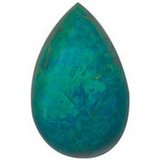
Chrysocolla jewelry
Chrysocolla is a hydrated copper silicate mineraloid prized for its blue-to-green coloration, formed in the oxidation zones of copper ore deposits. Its chemistry (Cu,Al)₂H₂Si₂O₅(OH)₄·nH₂O produces hues ranging from sky blue and teal to forest green, often in mottled or banded patterns. Most specimens are opaque with a waxy to vitreous luster when polished into cabochons. Because it rarely forms true crystals, chrysocolla is classified as a mineraloid rather than a crystalline mineral.
Origin and Key Properties of Chrysocolla
Commercial chrysocolla comes from copper-producing regions worldwide. Major sources include the Ray and Inspiration mines in Arizona, the Lily Mine in Peru, the Katanga copper belt in the Democratic Republic of the Congo, Israel's Timna Valley (historically mined for copper since the Bronze Age), Russia's Ural Mountains, and deposits in Chile and Mexico. The Mexican material known as Parrot Wing combines chrysocolla with iron and manganese oxides, producing the green-and-black banded look collectors favor.
Pure chrysocolla is soft, with a Mohs hardness of only 2.5 to 3.5, which makes it difficult to cut and polish on its own. Most gem-grade material on the market is actually chrysocolla chalcedony — chrysocolla intergrown with quartz — which raises the hardness to roughly 6 to 7 and allows it to take a high polish. This silicified variety is often sold as "Gem Silica" when the blue is saturated and translucent. Typical specimens are opaque; translucent Gem Silica is rare and commands higher prices.
Treatments are common. Softer chrysocolla is frequently stabilized with clear resin or epoxy to harden the surface and prevent chipping during setting. Some material is backed with a dark resin or adhered to a base stone (doublet construction) to reinforce thin slabs. Dyeing is uncommon, but assembled stones and stabilization should always be declared. Chrysocolla is also widely confused with turquoise; the two share a color range but differ in chemistry and hardness.
Chrysocolla in Sterling Silver Jewelry
Because chrysocolla is typically opaque, it is almost always cut as cabochons — oval, round, freeform, or teardrop shapes that highlight its color zoning and matrix patterns. Faceted pieces exist only in the translucent Gem Silica grade. Raw and drusy chrysocolla, where tiny quartz crystals coat a chrysocolla base, are also set in pendants and statement rings. The cool blue-green palette pairs well with the white tone of sterling silver (.925), which frames the stone without competing with its color the way yellow gold sometimes does. At SilverRush Style, most chrysocolla jewelry falls between $25 and $120, depending on stone size, grade, and setting complexity.
Bezel and shadow-box settings are preferred for chrysocolla because they protect the vulnerable edges of the cabochon and keep the stone seated securely. You will also find it combined with other copper-zone minerals such as malachite and azurite in mixed-matrix cabochons.
Care and Cleaning
Clean chrysocolla with a soft cloth and lukewarm water only. Skip ultrasonic and steam cleaners, which can crack stabilized stones or separate doublets. Avoid household chemicals, bleach, perfume, and prolonged sun exposure, since heat and UV may fade the copper-based color. Store each piece in a separate soft pouch so harder stones do not scratch the surface, and remove chrysocolla jewelry before showering, swimming, or gardening.
Frequently Asked Questions
Is chrysocolla a real gemstone?
Yes. Chrysocolla is a natural copper silicate mineraloid mined from oxidized copper deposits. Because pure material is soft (Mohs 2.5–3.5), most jewelry-grade chrysocolla is chrysocolla chalcedony — the same mineral intergrown with quartz — which reaches Mohs 6–7.
How can I tell chrysocolla from turquoise?
Chrysocolla tends toward green-blue with darker matrix patterns and is generally softer than turquoise. Turquoise shows a more uniform sky-blue body color and a different matrix (often black or brown spiderweb). A gemologist can confirm identity by specific gravity and refractive index testing.
Can chrysocolla get wet?
Brief contact with water is fine for silicified chrysocolla, but prolonged soaking can damage stabilized or unstabilized stones and the epoxy used in doublets. Remove the jewelry before bathing or swimming, and dry it promptly if it gets wet.
Where does the best chrysocolla come from?
Arizona produces much of the commercial supply, including top-grade Gem Silica from the Ray and Inspiration mines. Peru's Lily Mine yields saturated blue material, while Israel's Timna Valley and the DRC's copper belt are also historically significant sources.
Talk to Our Jewelry Experts
Monday to Friday from 9AM to 5PM EST
