


 NECKLACES

 Shop now, pay later
Charoite
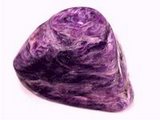
Charoite jewelry
Charoite is a rare silicate mineral prized for its violet-to-lilac color and swirling fibrous texture. Its chemical formula is K(Ca,Na)₂Si₄O₁₀(OH,F)·H₂O, placing it in the inosilicate (chain silicate) group. Colors run from pale lavender through deep purple, often interwoven with white quartz, black aegirine, and orange tinaksite, producing the marbled pattern that identifies the stone at a glance.
Charoite Origin and Key Properties
Charoite has only one commercial source on Earth: the Murun Massif near the Chara River in the Sakha Republic (Yakutia), Siberia, Russia. The deposit sits where a potassium-rich syenite intrusion altered surrounding limestone, creating a metasomatic rock unique to that roughly 10-square-kilometer area. The mineral was described and named in 1978, though Soviet geologists had encountered it earlier. Because the single mine operates under Russian export controls and annual output is limited, supply is finite and prices have climbed since the 2000s.
Charoite registers 5 to 6 on the Mohs scale, which is softer than quartz and calls for reasonable care in rings and bracelets. It is translucent to opaque with a pearly to silky luster and a conchoidal fracture. The best material shows strong chatoyancy — a moving sheen across the fibers — and saturated purple without excessive black aegirine or gray matrix. Specific gravity runs around 2.54 to 2.68.
Charoite is generally sold untreated. No routine dyeing, heating, irradiation, or fracture filling is applied to natural Russian material; the color and pattern are intrinsic. Some cabochons receive a light wax or polish to seal the surface after cutting. Buyers should be aware that purple "charoite" offered at unusually low prices online is occasionally dyed sugilite, quartzite, or resin composite, so source matters.
Charoite in Sterling Silver Jewelry
Charoite is cut almost exclusively as cabochons, freeform polished slabs, or beads, since its fibrous structure does not take a faceted cut well. Cabochons show the chatoyant silk and interlocking swirls to best effect. The cool violet tone pairs cleanly with sterling silver (.925); the bright white metal reinforces the lavender hues without pulling warmth into the stone, the way yellow gold can. At SilverRush Style, most charoite jewelry — pendants, rings, and earrings — falls in the $40 to $180 range, with larger statement pendants and cuffs reaching higher depending on cabochon size and grade.
When shopping, look for even color distribution, visible fibrous sheen, and a smooth polish without pits. Darker, more saturated purples with distinct white and black patterning command a premium over pale, washed-out material.
Care and Cleaning
Clean charoite with warm water, mild soap, and a soft cloth. Avoid ultrasonic and steam cleaners, which can penetrate the fibrous structure and loosen the polish. Keep the stone away from bleach, acetone, and abrasive cleaners, and remove jewelry before swimming in chlorinated pools. Store pieces separately in a soft pouch to prevent harder stones from scratching the surface, and limit prolonged direct sunlight to protect color intensity.
Frequently Asked Questions
Where does charoite come from?
Charoite is mined at a single location: the Murun Massif along the Chara River in Yakutia, Siberia, Russia. No other commercial deposit has been found, which is why it is classified as a rare mineral.
How hard is charoite?
Charoite measures 5 to 6 on the Mohs scale. It works well in pendants and earrings; in rings, choose protective bezel settings and avoid hard knocks against countertops and doorframes.
Is charoite treated or dyed?
Natural Russian charoite is not routinely treated. The purple color and swirling pattern are inherent to the mineral. Dyed imitations exist on the low-priced market, so buy from sellers who identify the source material.
Why is charoite expensive?
Supply comes from one small mine with restricted output and export. Combined with steady demand for its violet color and chatoyant fibers, the limited production keeps charoite priced above most common purple stones like amethyst.
Talk to Our Jewelry Experts
Monday to Friday from 9AM to 5PM EST
