

 NECKLACES

 Shop now, pay later All Bracelets & Necklaces & Earrings 96% OFF + Other 95% OFF
 Aquamarine
Aquamarine jewelry
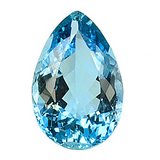
Aquamarine is a blue to blue-green variety of the mineral beryl, a beryllium aluminum silicate with the chemical formula Be₃Al₂Si₆O₁₈. Its color, which ranges from pale sky blue to deeper sea-blue and occasional greenish-blue, comes from trace iron (Fe²⁺) within the crystal lattice. The name traces to the Latin aqua marina, or "water of the sea," a nod to the pale oceanic tone that has defined the gem since antiquity.
Origin and Key Properties of Aquamarine
Brazil remains the most important source of gem-grade Aquamarine, with Minas Gerais producing the majority of commercial rough since the 19th century. The Santa Maria de Itabira mine gave its name to "Santa Maria" aquamarines — material with a saturated medium-blue color that still sets the benchmark for quality. Additional deposits are worked in Madagascar, Mozambique, Nigeria, Kenya, Zambia, Pakistan, and the Ural region of Russia. Colorado's Mount Antero supplies small quantities of well-formed crystals from the US side.
Aquamarine measures 7.5 to 8 on the Mohs scale, making it hard enough for daily wear in rings and bracelets. It is typically transparent with strong pleochroism: a faceted stone viewed down one axis can read nearly colorless, while the perpendicular direction shows the stronger blue. Specific gravity sits around 2.68–2.74, and the crystal habit is hexagonal prisms, sometimes reaching meters in length in pegmatite pockets.
Heat treatment is standard and accepted in the trade. Most rough Aquamarine is naturally greenish or yellow-green; heating to roughly 400–450°C drives off the Fe³⁺ component and leaves a pure blue. The change is permanent and stable. Irradiation is not commonly used on aquamarine, and fracture-filling is rare. Reputable sellers assume heat and disclose any other treatment.
Aquamarine in Sterling Silver Jewelry
Because the color saturation in most aquamarines is light, cutters favor faceted shapes that maximize return of light through the stone — emerald, oval, pear, cushion, and round brilliants dominate the market. Larger sizes (above 3–5 carats) hold color better than smaller melee. Cabochon cuts show up in lower-clarity material and in pieces that emphasize the watery glow rather than brilliance. Raw crystal slices and rough prisms are set for a more mineral, collector-style look.
Sterling silver (.925) pairs well with aquamarine because the cool white metal reinforces the blue without pulling warm tones into the stone, as yellow gold sometimes does. Rhodium-plated and oxidized silver finishes both work. At SilverRush Style, aquamarine jewelry generally runs from about $30 for small stud earrings and simple pendants to $150–$250 for statement rings and multi-stone necklaces with larger faceted centers.
Care and Cleaning
Clean aquamarine with warm water, mild dish soap, and a soft brush. Ultrasonic and steam cleaners are usually safe for untreated stones, but avoid them if the stone has visible fractures or liquid inclusions. Keep the gem away from household bleach, acetone, and acidic cleaners. Prolonged direct sunlight can fade color over years, so store pieces in a fabric pouch or lined box separate from harder stones like topaz, sapphire, or diamond.
Frequently Asked Questions
Is aquamarine a valuable stone?
Aquamarine is a mid-range colored gemstone. Pale commercial material is affordable, while deeply saturated "Santa Maria" and "Santa Maria Africana" stones from Brazil and Mozambique command several hundred to several thousand dollars per carat. Size, clarity, and color depth drive price more than origin alone.
Can aquamarine be worn every day?
Yes. With a Mohs hardness of 7.5–8, aquamarine handles daily wear in rings, pendants, and earrings. Protective settings are still recommended for ring centers, since a hard knock against a countertop can chip any beryl along its cleavage direction.
How can I tell if an aquamarine is real?
Natural aquamarine shows pleochroism — rotate the stone and the blue intensity shifts. It also typically contains faint liquid or "rain" inclusions under 10x magnification. Glass imitations are singly refractive and show bubbles; synthetic spinel and blue topaz require a refractive index reading to separate. A gemological lab report is the reliable answer for higher-value pieces.
What is aquamarine's birthstone month?
Aquamarine is the modern birthstone for March and the traditional gift for the 19th wedding anniversary.
Talk to Our Jewelry Experts
Monday to Friday from 9AM to 5PM EST
Recently Viewed