


 NECKLACES

 Shop now, pay later
Ammonite
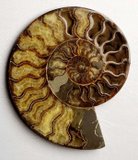
Ammonite is a fossilized marine cephalopod whose coiled, chambered shell has mineralized over 65 to 400 million years into a collectible gemstone material. Because it is a fossil rather than a single mineral species, its chemistry reflects the replacement minerals — usually calcite, aragonite, pyrite, or silica (CaCO₃ or SiO₂) — that filled the original shell. Colors in standard ammonite specimens run through brown, beige, tan, caramel, and gray, often with concentric banding that traces the animal's growth chambers.
Ammonite Origin and Key Properties
Ammonites lived worldwide during the Mesozoic Era (Triassic through Cretaceous, roughly 240 to 65 million years ago) and went extinct alongside the non-avian dinosaurs. Today, commercial fossil material comes from Madagascar (the primary source for brown and beige polished halves), Morocco's Atlas Mountains, the Jurassic Coast of England near Whitby and Lyme Regis, Germany's Holzmaden shales, and the Pierre Shale formation in South Dakota and Alberta. The iridescent red-and-green variety known as ammolite is mined almost exclusively from the Bearpaw Formation in southern Alberta, Canada.
Hardness ranges from 3.5 to 4.5 on the Mohs scale when the shell is preserved as calcite or aragonite, climbing to 6.5 when silica replacement has occurred. The stone is opaque, with a pearly to vitreous luster on polished faces. Typical specimens show brown, beige, or gray body color; pyritized ammonites from Russia and Germany read gold, while Madagascan cross-sections often reveal crystalline calcite infills in white or amber tones.
Treatments are common and worth knowing about. Most commercial ammonite slices are stabilized with clear resin or epoxy to seal porous chambers and prevent cracking. Surfaces are routinely polished, and some pieces are backed with a stabilizing doublet. Ammolite is almost always sold as a triplet — a thin natural layer bonded between a shale backing and a quartz or spinel cap — to protect the fragile iridescent film.
Ammonite in Sterling Silver Jewelry
Because ammonite is soft and irregular, lapidaries cut it as freeform cabochons, matched pairs for earrings, and full polished halves that show the internal suture pattern. Raw, unpolished edges are often left visible to preserve the fossil character. Sterling silver (.925) suits the stone for two practical reasons: the cool white metal sharpens the contrast of warm brown and beige banding, and silver bezels can be built tall enough to protect the vulnerable edges of a soft fossil. Our ammonite jewelry typically runs from $40 for small pendants to $180 for statement pieces featuring large matched halves or premium Madagascan material.
Settings lean toward bezel-set pendants, wire-wrapped rings, and drop earrings where the spiral faces outward. Larger specimens are set as focal pendants on snake or box chains, which keeps the weight balanced against the silver.
Care and Cleaning
Clean ammonite with a soft cloth dampened in lukewarm water and mild soap, then dry immediately. Skip ultrasonic and steam cleaners — vibration and heat can separate resin stabilization and crack doublets. Keep the stone away from household chemicals, perfume, chlorinated pools, and prolonged direct sunlight, which can dull iridescent ammolite. Store pieces individually in a soft pouch to prevent harder gems from scratching the surface.
Frequently Asked Questions
Is ammonite a crystal or a fossil?
Ammonite is a true fossil — the preserved shell of an extinct marine cephalopod. Over millions of years, minerals such as calcite, aragonite, pyrite, or silica replace the original shell material, which is why ammonite is sold and worn as a gemstone even though it began as a living animal.
How old is ammonite used in jewelry?
Most jewelry-grade specimens date from the Jurassic and Cretaceous periods, roughly 65 to 200 million years old. Madagascan brown ammonites are typically Cretaceous, while British Whitby fossils and German pyritized pieces come from Jurassic shale beds.
Can ammonite get wet?
Brief contact with water is fine for cleaning, but ammonite should not be soaked or worn swimming. The stone is porous, soft (Mohs 3.5 to 4.5), and often stabilized with resin that can degrade with prolonged moisture or chlorine exposure.
What is the difference between ammonite and ammolite?
Ammonite refers to the fossil shell itself, usually shown in brown, beige, or gray polished form. Ammolite is the rare iridescent gem material formed from the outer nacreous layer of ammonites found in Alberta's Bearpaw Formation, showing red, green, and blue color play. Ammolite is significantly more expensive and almost always sold as a protective triplet.
Talk to Our Jewelry Experts
Monday to Friday from 9AM to 5PM EST
