


 NECKLACES

 Shop now, pay later
Amber
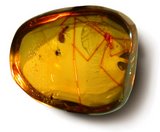
Amber jewelry
Amber is fossilized tree resin from ancient conifers, hardened over 30 to 90 million years into a warm organic gem that ranges from pale lemon and honey gold through cognac, cherry red, and rare greens and blues. Chemically it is an organic compound approximating C₁₀H₁₆O₂ (carbon, hydrogen, and oxygen), not a true mineral. Its low density lets it float in saltwater, and many pieces carry inclusions — trapped insects, pollen, bark fragments, and gas bubbles — that confirm organic origin and add collector value.
Amber Origin and Key Properties
The dominant source is the Baltic region, where succinite is extracted along the coasts of Poland, Lithuania, and Russia's Kaliningrad Oblast, which alone holds an estimated 90% of the world's commercial reserves. Baltic amber contains 3–8% succinic acid, a higher level than deposits elsewhere. Other notable sources include the Dominican Republic (home to rare blue amber that fluoresces under UV), Chiapas in Mexico, Myanmar (burmite, roughly 99 million years old with Cretaceous inclusions), and smaller finds in Romania, Sicily, and Lebanon. The Amber Road trade route carried Baltic material to the Mediterranean from about 1900 BCE onward.
On the Mohs scale amber measures 2 to 2.5, putting it among the softest gem materials — softer than a fingernail in some cases. Specific gravity runs 1.05–1.10, refractive index around 1.54, and transparency varies from fully clear to cloudy or opaque depending on trapped micro-bubbles. Fracture is conchoidal, and the surface takes a soft resinous luster rather than a glassy polish.
Treatments are common and should be disclosed. Heat and pressure in an autoclave (often called "clarified" or "clarified Baltic" amber) drives out cloudiness and produces the sun-spangle internal discs many shoppers recognize. Dyeing deepens cognac or produces green and cherry tones. Pressed amber, also labeled "ambroid," is made by fusing smaller fragments under heat — it is still genuine amber but sells at a lower tier. Avoid material described only as "copal," which is young resin under a million years old and not true amber.
Amber in Sterling Silver Jewelry
Because amber is soft and heat-sensitive, cutters favor cabochons, polished freeforms, smooth beads, and carved shapes over faceting; faceted amber exists but is less common. Sterling silver (.925) is the standard setting metal at SilverRush Style for several practical reasons: it is lightweight enough for large cabochons without straining earlobes, its cool white tone makes honey and cognac hues read warmer, and bezel settings in silver protect the soft stone edges from chips. Our amber jewelry collection spans rings, pendants, earrings, bracelets, and brooches, with most pieces priced between $25 and $150 depending on size, clarity, and whether inclusions are present.
Care and Cleaning
Clean amber with lukewarm water, a drop of mild soap, and a soft cloth — then dry fully. Never use ultrasonic or steam cleaners, and keep amber away from perfume, hairspray, alcohol, acetone, and household solvents, all of which etch the surface. Prolonged sunlight and dry heat can cause crazing (fine surface cracks), so store pieces in a soft pouch away from radiators and direct sun. Apply cosmetics and fragrance before putting jewelry on.
Frequently Asked Questions
How can I tell if amber is real?
Real amber floats in a saturated saltwater solution (about two tablespoons of salt per cup of water), while plastic and glass sink. It also warms quickly in the hand, carries a resinous pine scent when gently rubbed, and shows natural inclusions that look irregular rather than evenly placed.
Is Baltic amber better than other types?
Baltic amber (succinite) is the most established commercially because of its 3–8% succinic acid content, consistent supply, and long cutting tradition. Dominican blue amber and Burmese burmite are rarer and often more expensive, but "better" depends on the color and inclusions you want.
Does amber fade or change over time?
Amber oxidizes slowly with exposure to air and light, darkening from honey toward a deeper cognac over decades. Rapid changes usually indicate overheating, solvent damage, or dehydration; steady wear and proper storage keep the color stable.
Can amber jewelry get wet?
Brief contact with fresh water is fine, but remove amber before swimming, showering, or using hot tubs. Chlorine, salt water, and soap residue dull the polish, and repeated wet-dry cycles can promote surface crazing on older stones.
Talk to Our Jewelry Experts
Monday to Friday from 9AM to 5PM EST
