


 NECKLACES

 Shop now, pay later
Amazonite
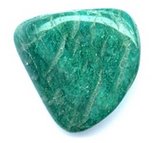
Amazonite jewelry
Amazonite is a green to blue-green variety of microcline, a potassium feldspar with the chemical formula KAlSi₃O₈. Its color ranges from pale mint through teal to a deeper blue-green, often with white streaks or grid-like patterning from intergrown albite. The stone is opaque to translucent and takes a soft, waxy polish that reads well against sterling silver.
Origin and Key Properties of Amazonite
The stone takes its name from the Amazon River, though no verified deposits have ever been documented in the Amazon basin — the naming is historical confusion. Commercial Amazonite has long come from the Ilmen Mountains near Miass, Russia, where it occurs in granitic pegmatites. The most significant modern source is Pike's Peak, Colorado, where gem-grade crystals grow alongside smoky quartz, orthoclase, and albite. Additional material comes from Madagascar, Brazil, Ethiopia, India, Namibia, and Virginia.
Amazonite rates 6 to 6.5 on the Mohs scale, which places it below quartz. It has two directions of perfect cleavage, so sharp impacts can split a stone along those planes. Luster is vitreous on fresh surfaces and slightly pearly on cleavage faces. The blue-green color comes from trace lead combined with structural water — not copper, as was assumed for decades. Color is typically uneven, and the best rough shows strong saturation with crisp white albite banding.
Most Amazonite on the market is untreated. Color is natural. Some lower-grade material is waxed or impregnated with colorless resin to stabilize fractures and improve polish, and dyed imitations occasionally appear. We source natural, untreated Amazonite and disclose any stabilization.
Amazonite in Sterling Silver Jewelry
Amazonite is almost always cut as cabochons — ovals, rounds, rectangles, and freeforms — because the stone is opaque and its value lies in color and pattern rather than brilliance. Faceted Amazonite exists but is less common and usually reserved for translucent material. Raw and tumbled pieces are popular in statement pendants and cuffs. The cool green-blue reads cleanly against the white metal of sterling silver (.925), and silver bezels protect the cleavage-prone edges better than prong settings. Our amazonite jewelry collection typically runs from about $30 for small stud earrings to $150 for larger pendants and statement rings.
Because Amazonite is softer than many jewelry stones, it suits pieces that don't take daily impact: earrings, pendants, brooches, and occasional-wear rings. For rings worn often, look for bezel-set cabochons rather than exposed faceted stones.
Care and Cleaning
Clean Amazonite with warm water, mild soap, and a soft cloth or soft brush. Avoid ultrasonic and steam cleaners — vibration can exploit the cleavage planes. Keep the stone away from ammonia, bleach, acetone, and acidic cleaners. Prolonged direct sunlight can fade the color over time, so store pieces in a lined box or pouch, separate from harder stones that could scratch the surface.
Frequently Asked Questions
Where is Amazonite found?
The main commercial deposits are in Colorado (Pike's Peak region), Russia (Ilmen Mountains near Miass), Madagascar, Brazil, Ethiopia, and Namibia. Despite the name, no significant Amazonite has been mined in the Amazon basin.
Is Amazonite a real gemstone?
Yes. Amazonite is a natural gem variety of microcline feldspar, the same mineral family as moonstone and sunstone. Its blue-green color comes from trace lead content within the crystal structure.
Is Amazonite durable enough for daily wear?
At 6 to 6.5 on the Mohs scale with perfect cleavage, Amazonite is moderately durable. It works well for earrings, pendants, and occasional-wear rings, but it can chip or scratch if worn daily in high-contact settings. Bezel settings offer better protection than prongs.
Is Amazonite treated or dyed?
Most Amazonite sold is untreated — the color is natural. Some lower-grade stones are waxed or resin-stabilized to improve polish and fill fractures. Dyed imitations exist but are uncommon in reputable jewelry. Ask your seller for disclosure on any treatments.
Talk to Our Jewelry Experts
Monday to Friday from 9AM to 5PM EST
