


 NECKLACES

 Shop now, pay later All Bracelets & Necklaces 96% OFF + All Rings 96% OFF
 Abalone
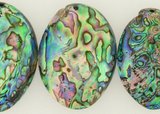
Abalone jewelry
Abalone is an organic gem material formed from the iridescent inner shell (nacre) of sea snails in the family Haliotidae. Unlike crystalline minerals, Abalone is a biomineral composed primarily of calcium carbonate (aragonite) platelets bonded by a protein matrix called conchiolin, which produces its signature play of green, blue, pink, and violet color. Its opaque body and swirling pattern make each cabochon visually distinct.
Origin and Key Abalone Properties
Abalone shells are harvested from cold coastal waters worldwide. The most prized sources include New Zealand (where the species Haliotis iris yields the deeply colored pāua), California and the Pacific coast of Mexico (red and green abalone), South Africa (perlemoen), Japan, and Australia. California's commercial abalone fishery closed in 1997 due to population decline, so most material on today's market comes from New Zealand pāua and farmed sources in Asia and South Africa.
Chemically, Abalone is about 95% calcium carbonate (CaCO₃) in the aragonite form, with the remainder organic conchiolin. It is opaque, with a Mohs hardness of roughly 3.5 to 4 — softer than turquoise and considerably softer than quartz. Colors run across the spectrum: peacock green, electric blue, rose pink, bronze, and deep violet, often layered in the same piece. The iridescence comes from light interference across the stacked aragonite platelets, not from pigment.
Treatments are common and worth knowing about. Most Abalone used in jewelry is stabilized with clear resin to harden the surface and prevent chipping. Many pieces are also backed with a dark resin or composite (doublet construction) to deepen the color and add structural support to thin shell sections. Dyed Abalone exists but is less common; reputable sellers disclose it.
Abalone in Sterling Silver Jewelry
Because Abalone is too soft and layered to facet, it is almost always cut as a cabochon — flat-backed ovals, teardrops, rectangles, and free-form shapes that showcase the color flash. Inlay work is the second major format, with thin shell slices set flush into silver channels for rings, pendants, and cuff bracelets. Occasionally you'll see raw shell segments set in bezel frames for a more organic look.
Sterling silver (.925) is the standard setting metal for Abalone for practical and visual reasons. The cool white tone of silver amplifies the shell's blues and greens without competing with them, and silver bezels protect the soft edges from impact. At SilverRush Style, our abalone jewelry typically runs $25 to $90 for rings and pendants, with larger statement cuffs and multi-stone pieces reaching $120 or more. Explore the full gemstone jewelry collection for related options.
Care and Cleaning
Clean Abalone with a soft cloth dampened in mild soapy water, then dry immediately. Never use ultrasonic cleaners, steam, ammonia, bleach, or acetone — these will strip the stabilizing resin and dull the nacre. Keep Abalone away from prolonged sun exposure, perfume, hairspray, and chlorinated pools. Store each piece in a soft pouch, separated from harder stones and silver polishing cloths.
Frequently Asked Questions
Is Abalone a stone or a shell?
Abalone is an organic gem, not a mineral stone. It is the nacreous inner lining of sea snail shells in the Haliotidae family. Gemologically it is grouped with pearl, coral, and amber as an organic material used in jewelry.
Is Abalone durable enough for daily wear?
At 3.5 to 4 on the Mohs scale, Abalone scratches more easily than quartz or agate. It works well for pendants, earrings, and occasional-wear rings. For everyday rings, choose a protective bezel setting and remove the piece before manual work or swimming.
Why does Abalone show so many colors?
The color is structural, not pigmented. Thin, stacked aragonite platelets refract and interfere with light at different wavelengths, producing shifting greens, blues, pinks, and purples as the viewing angle changes. This effect is called iridescence or orient.
Is Abalone sold at SilverRush Style treated?
Most Abalone cabochons we set are stabilized with clear resin to protect the nacre, and many are backed with dark composite to support thin shell sections. This is standard industry practice and does not change the natural color of the shell.
Talk to Our Jewelry Experts
Monday to Friday from 9AM to 5PM EST
